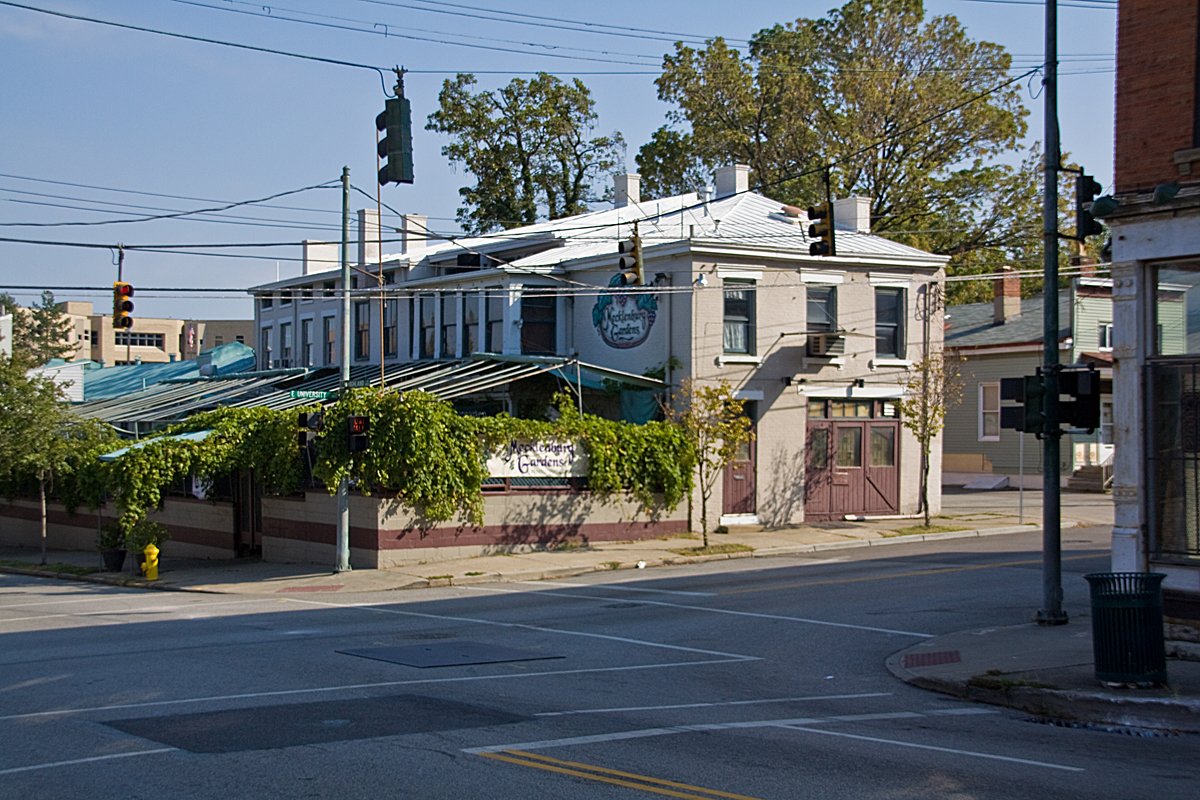
In the Corryville neighborhood of Cincinnati, Ohio, a rectangular brick building on a stone foundation was constructed circa 1865, perhaps as a house. By 1870, the Italianate structure was converted into a restaurant. During these early years, it was run by John Neeb, who sold the establishment to an employee in 1886. The new owner, Louis Mecklenburg, changed the name from "Mount Auburn Garden Restaurant" to "Mecklenburg Gardens" and converted the saloon into a heavily German beer garden. This catered to a massive influx of German immigrants, who made up as much as 25% of the city's population.
As the business prospered, it expanded to include a walled outdoor eating area shaded by awnings and trellises covered in grapevines. During the 20th century, the Gardens underwent various changes. Under Prohibition, it operated covertly as a speakeasy as well as a legal restaurant, with patrons knowing whether they could purchase alcohol based on the position of a ship model on a counter. In the 1970s, the building underwent a structural restoration while owned by an ashram.
After closing multiple times during the late twentieth century, Mecklenburg Gardens reopened in 1996. The restaurant was listed on the National Register of Historic Places in 1976. The interior features several small dining rooms and a central pub area to accommodate patrons. The German restaurant and beer garden closed permanently in 2023.
Sources: Wikipedia, OpenStreetMap, Wikidata, Wikimedia Commons
Written by No Other
Discuss this with the author and others
No comments yet. Be the first to start the conversation.