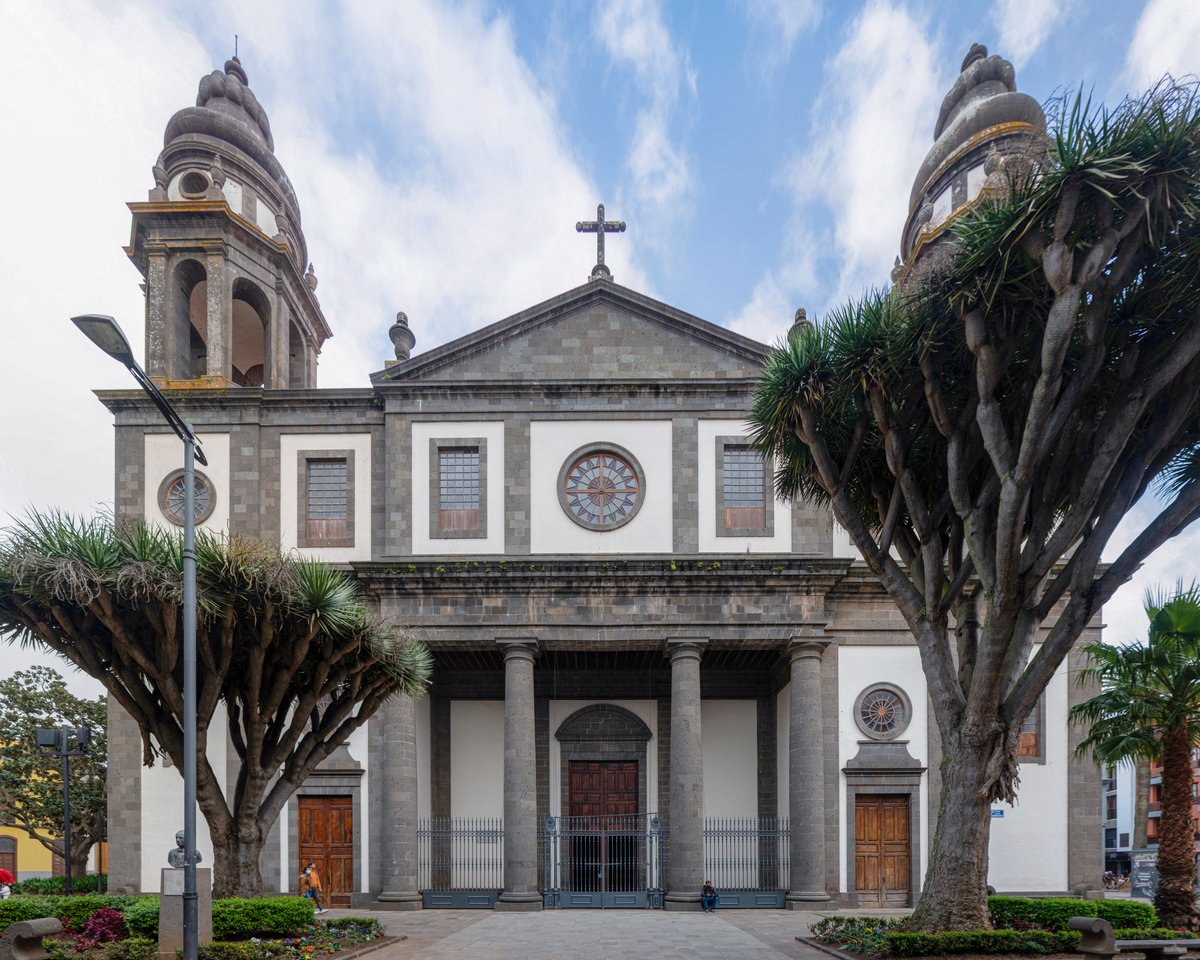

Long before the high arches pierced the sky, the soil of the valley of Aguere held an ancient Guanche necropolis. In 1511, a hermitage was erected on the site by order of the conquistador Alonso Fernández de Lugo. This area, which once featured a large lake, served as a place of pilgrimage for the indigenous people of the island.
By 1515, the chapel was replaced by a major construction in the Mudéjar architectural style dedicated to the Virgin of Los Remedios. That same year, the Portuguese mason Miguel Alonso built the main chapel, the main arch, the altar, the stands, the tabernacle, and the door of the sacristy out of stone. The site rose to the level of a parish in 1515, and for years, various requests were made to have the temple designated as a cathedral or collegiate church.
Finally, on 1 February 1819, a papal bull approved the division of the Diocese of Canarias into two dioceses. The temple became a cathedral, and the new diocese of La Laguna was created. The building was constructed between 1904 and 1915 to replace an earlier structure, featuring a Neoclassical facade inspired by the Cathedral of Pamplona and a prominent dome that dominates the cityscape.
Within these walls lie the remains of Alonso Fernandez de Lugo, the conqueror of the island and founder of the city. Today, the cathedral stands as a National Historic-Artistic Monument and a World Heritage Site. It remains a parish and a Marian shrine, serving as the mother church of the diocese which includes the islands of Tenerife, La Palma, La Gomera, and El Hierro.
Sources: Wikipedia, OpenStreetMap, Wikidata, Wikimedia Commons
Written by Mutabor
Discuss this with the author and others
No comments yet. Be the first to start the conversation.