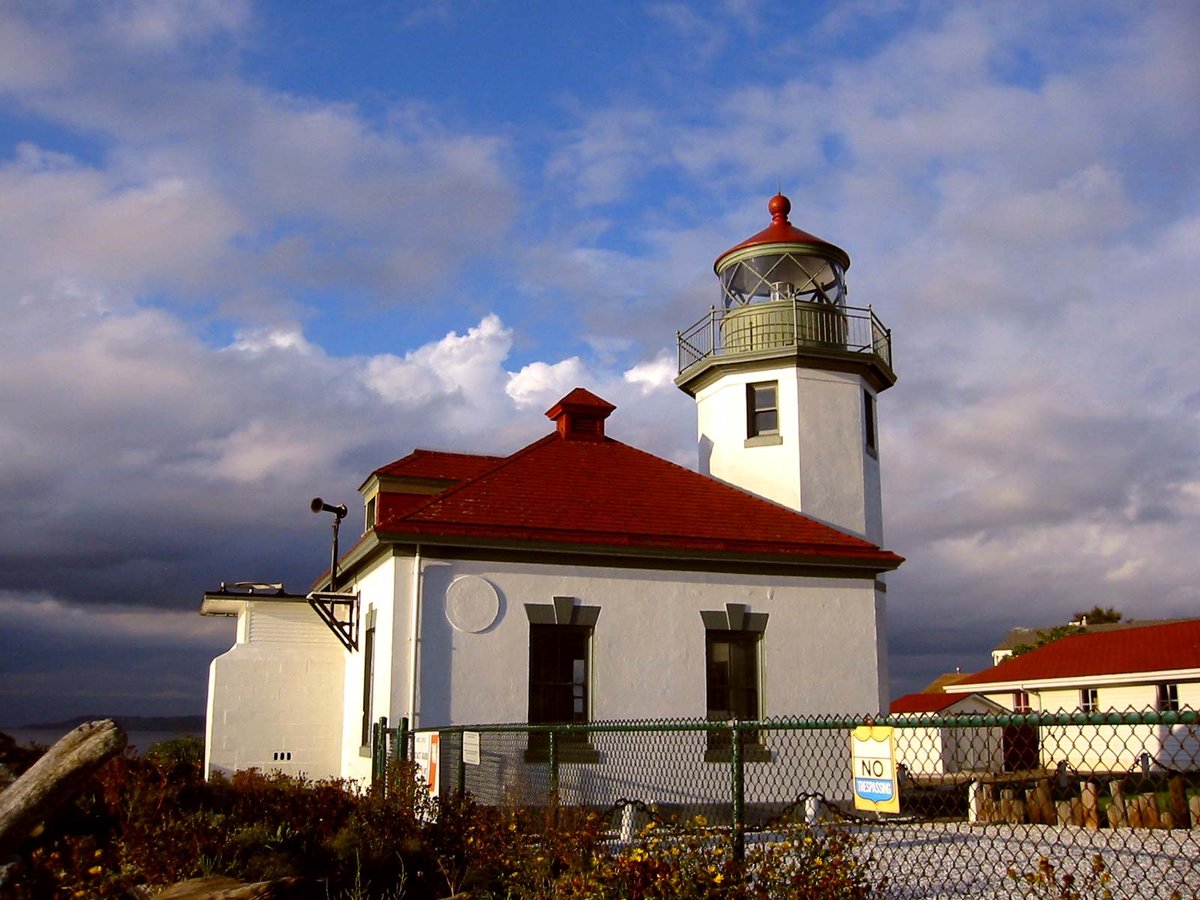
In the 1870s, farmer Hans Martin Hanson hung an unofficial kerosene lantern on the side of his barn at the southern entrance to Elliott Bay. In 1887, the United States Lighthouse Board recognized the need for an official light and placed a lens-lantern atop a wooden post at the point. Because Hanson remained the owner of the property, he was assigned as the first official lightkeeper for a salary of $15 per month.
Eventually, Hanson's son Edmund sold the point to the government in 1910. By 1913, the authorities completed the current structure - a 37-foot (11 m) octagonal brick tower with a lantern and gallery, attached to a 1-story brick fog signal building. The tower is a twin of the Point Robinson Lighthouse on Maury Island, which was built two years later.
The tower originally held a fourth order Fresnel lens that was visible at no less than 12 miles (19 km). In 1962, the original Fresnel lens was replaced by a VRB-25 aerobeacon. The station was automated in 1984, and the principal keeper's quarters became the home of the Commander of the Thirteenth Coast Guard District after modernization.
Today, the active light station remains in the hands of the U.S. Coast Guard. The U.S. Coast Guard Auxiliary periodically offers tours of the station, where the brick fog signal building still stands alongside the tower.
Sources: Wikipedia, OpenStreetMap, Wikidata, Wikimedia Commons

Written by Kyle McLonely
Discuss this with the author and others
No comments yet. Be the first to start the conversation.