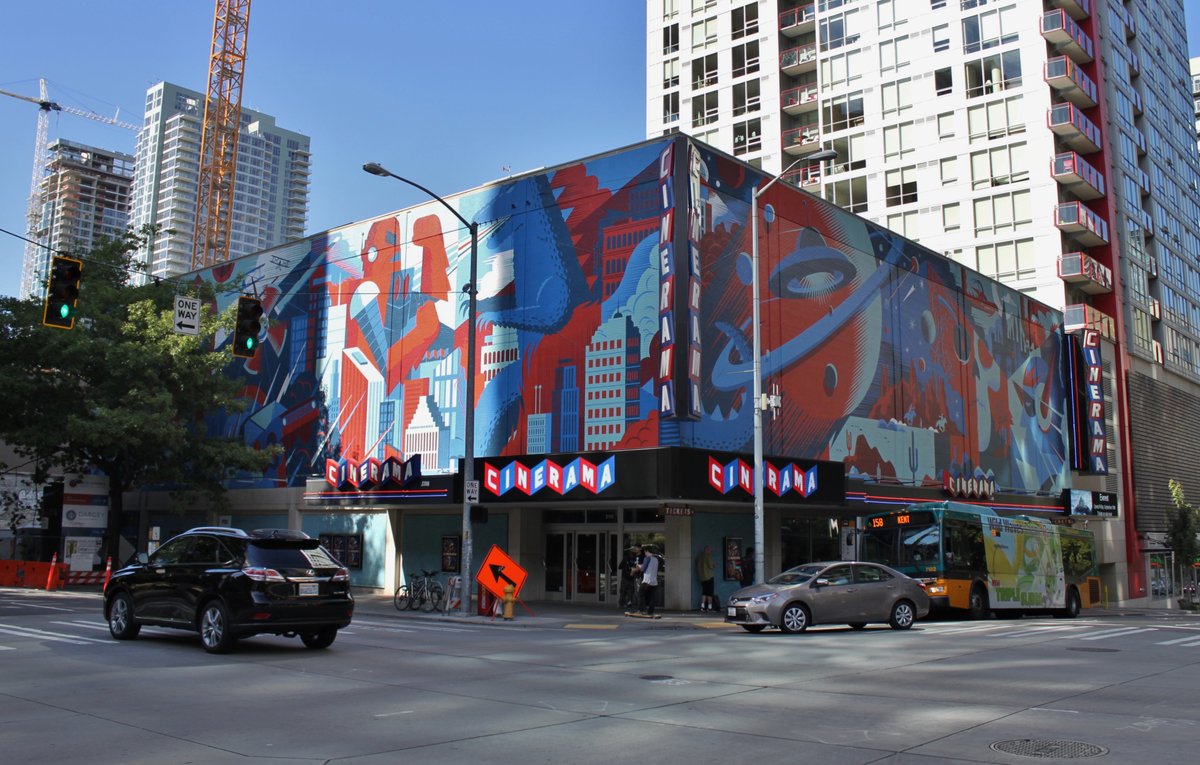
In 1997, developers planned to turn this theater into a dinner theater or a rock-climbing club. Local film buffs organized a grassroots protest to save the historic venue. Paul Allen purchased the theater in 1997 to prevent its conversion into a rock-climbing club and initiated a multimillion-dollar restoration of the theater.
The venue opened in 1963 as Seattle's Martin Cinerama. It was quickly modified to show 70mm films on a massive curved screen. That screen is 90 feet long and 30 feet high, constructed from 2,000 louvered strips. It stays tucked away behind a smaller screen until a professional crew arrives to dismantle the small one and assemble the big one for special presentations.
The theater underwent a major digital overhaul in 2010, which added a new digital projection and sound system with 3-D film support, along with a new marquee and signage. In 2014, a third renovation reduced the theater's capacity from 798 to 560 seats. This update provided wider seats, more leg room, a Dolby Atmos sound system, and the world's first commercial installation of a Christie 6P dual laser projector.
Today, it operates as SIFF Cinema Downtown. You can see the massive architecture of the original Cinerama era, now serving the Seattle International Film Festival. It is still a venue that knows how to handle a truly oversized image, following its 2023 purchase by the Seattle International Film Festival.
Sources: Wikipedia, OpenStreetMap, Wikidata, Wikimedia Commons

Written by Kyle McLonely
Discuss this with the author and others
No comments yet. Be the first to start the conversation.