Northern Cyprus: Stories, Legends, and People

For Browsing

The Turkish Republic of Northern Cyprus, TRNC (also sometimes referred to by the neutral abbreviation Northern Cyprus) is a partially recognized state occupying the northern third of the island of Cyprus, located within the borders of the Republic of Cyprus. It is recognized only by Turkey and heavily depends on its economic, political, and military support. Turkey stations a contingent of its troops in Northern Cyprus with the support of the TRNC; the Republic of Cyprus and the UN consider it an occupying force. The republic is a member of the Organization of Islamic Cooperation and the Organization of Turkic States as an observer. The population of the Turkish Republic of Northern Cyprus is about 294,906 people living in an area of 3,355 square kilometers (including the small Kokkina semi-exclave). The overwhelming majority of the population are ethnic Turks, representing two communities: local Turkish Cypriots (about half) and Anatolian Turks, settlers from Turkey. There are also remnants of Greek Cypriots and Maronite Lebanese who have remained in their enclaves. The capital of the TRNC is the city of Lefkoşa (effectively the northern part of Nicosia, divided between the Republic of Cyprus and the TRNC). The TRNC is separated from the rest of Cyprus by a buffer zone. The line dividing the island into two sectors (the so-called "Green Line") is guarded by the UN Peacekeeping Force in Cyprus (UNFICYP — abbreviation for United Nations Peacekeeping Force in Cyprus).

Former Cathedral of Saint Nicholas or Lala Mustafa Pasha Mosque

Mahmut Celaleddin Street no:42, Gazimağusa 99450

In the central square of Famagusta stands the Gothic Cathedral of Saint Nicholas. It is the finest example of Gothic church architecture in Cyprus, and today it is a mosque. This temple has had many names: originally — the Cathedral of Saint Nicholas, then Ayasofya Magusa or Aya Sofya "Holy Wisdom," and the latest — the Lala Mustafa Pasha Mosque. This temple has a special fate — a Christian cathedral that became a mosque. This makes the sanctuary even more unique; the combination of Gothic architecture and a minaret is surprising and impressive.

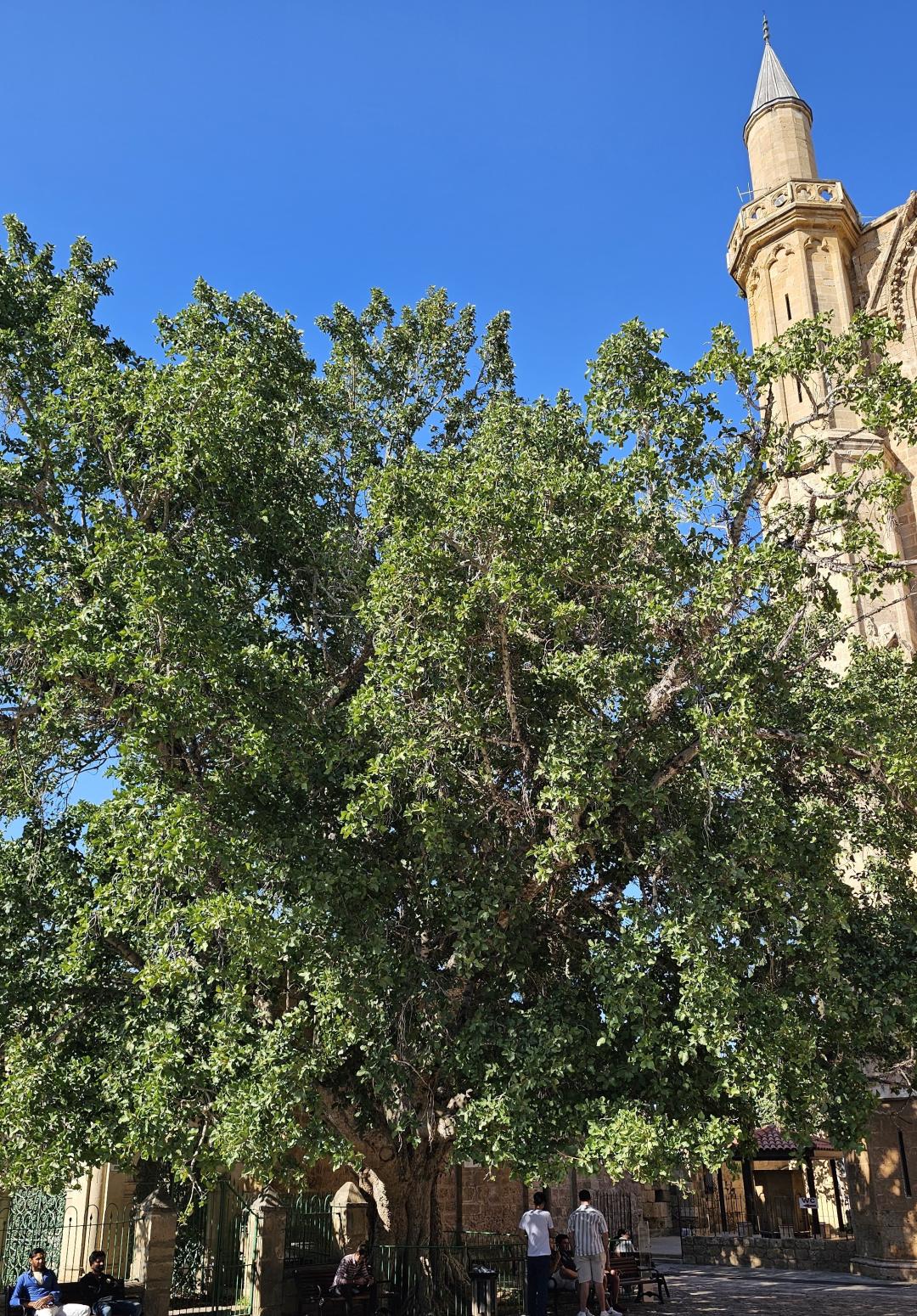
Ancient fig tree by the Cathedral of Saint Nicholas

4WFR+VVW, Mahmut Celaleddin St, Famagusta 99450

Next to the entrance of the cathedral (mosque) grows an ancient fig tree, over 700 years old — the oldest on Cyprus. According to legend, it was planted during the construction of the temple.

Othello Castle (Desdemona's) in Famagusta

Otello Castle, Othello St, Famagusta 99450

A fortress in the city of Famagusta in Cyprus, now located in the territory of the Turkish Republic of Northern Cyprus. In tourist literature and guidebooks, it is called Othello's Castle (Tower) or Desdemona's Castle (characters from Shakespeare's play "Othello"). The fortress stands in the northeastern part of the old city, directly adjacent to the fortress wall surrounding the cargo port.

Monastery of Saint Apostle Barnabas

Street, 9-27, Tuzla 99500

On the outskirts of Famagusta, on a small hill overlooking the vast ancient city of Salamis, stands a two-domed church dedicated to Saint Barnabas, the patron saint of Cyprus.

Varosha: How the War Preserved the Cypriot City in 1974

4X44+85X, Famagusta 99450

Varosha is a district in the city of Famagusta in Cyprus. Before the Turkish invasion, it was a popular tourist destination, but then it became a "ghost town." It is under protection (though it has been looted), and tourists are allowed to enter. In the 1960s and 1970s, Famagusta was the main tourist center in Cyprus. Due to the growing number of tourists, many new hotels and tourist facilities were built in the city, with a particularly large number appearing in Varosha. From 1970 to 1974, the city was at the peak of its popularity and was favored by many famous figures of that time. Among the stars who visited were Elizabeth Taylor, Richard Burton, Raquel Welch, and Brigitte Bardot. Varosha housed many modern hotels, and its streets were filled with numerous entertainment venues, bars, restaurants, and nightclubs. One of Varosha's hotels was opened just three days before the city was abandoned by its residents. Some of Varosha's hotel complexes are still legally private property owned by citizens from 20 countries around the world.