

Christ had twelve disciples (future messengers – apostles). But later their circle was expanded to seventy people, among whom were Barnabas (Joseph) and Paul (Saul), whose names are firmly connected with the history of Cyprus.
Saint Barnabas was a Jew from Salamis. Born Joseph, he went to the Holy Land to study law, where he met the apostle Paul. Receiving education in Jerusalem, Barnabas witnessed some of Jesus' miracles and accepted Christianity in 33 AD. He distributed his inherited family property to the early church and the poor of Jerusalem.
Barnabas returned to Cyprus together with Paul and Mark in 45 AD. During this visit to the island, they managed to accomplish much. In Kition (today’s Larnaca), Lazarus, resurrected by Christ, was ordained bishop. Iraklidius, baptized by Barnabas, became bishop of Tamassos, and Aristocleanos became bishop of Amathus. In Paphos, Paul succeeded in converting the Roman proconsul Sergius Paulus to Christianity. After completing their mission, they left the island. Barnabas returned here several years later and never left Cyprus again.
Becoming the archbishop of Salamis, Barnabas made such an impression on the Roman ruler of the island, Sergius Paulus, that he himself embraced the faith — Cyprus, in turn, became the first region in the world with a Christian ruler. The life and death of Barnabas are surrounded by numerous legends. According to one, the apostle was arrested in Salamis and executed on fabricated charges. He was slandered by a scoundrel named Bar-Joseph, who posed as an Eastern seer and magician. Barnabas was stoned, and his body, weighted down, was thrown into the sea.
The apostle’s disciples managed to retrieve the body from the sea bottom and buried it in an underground crypt. However, followers later found Barnabas’s remains and secretly reburied him in a tomb under a carob tree west of the Salamis necropolis. His companion John Mark placed a copy of the Gospel of Matthew on Barnabas’s chest. The tomb of Saint Barnabas remained undiscovered for more than 400 years, until the 5th century AD, but the exact location of the grave remained unknown, as Barnabas’s followers soon left the island due to persecution.
Four centuries later, in 478 AD, Archbishop Anthemios of Cyprus had a dream in which he descended into the crypt and saw the relics of the apostle Barnabas. Upon waking, he recorded the dream and began searching for the burial site. He found it by several landmarks and ordered digging there. After some time, the entrance to the crypt was excavated, and inside were the relics of the apostle Barnabas with a manuscript of the Gospel on his chest. This was a sensational discovery. Emperor Zeno, to whom the find was delivered, granted Archbishop Anthemios the right to wear purple imperial robes and sign documents with red “imperial” ink. The Church in Cyprus gained the right to be called Apostolic, as well as “autocephaly” — independence, which gave the right to manage internal affairs independently of the patriarchate. Although later the Cypriot Church suffered numerous attacks, claims to autocephaly were considered completely unfounded. Moreover, the miraculous find, the Gospel of Matthew, after thorough research was recognized not as the original but as one of its early copies. Emperor Zeno did not revoke his decision, as the excitement about the find was significant. A place was chosen at the grave site for the construction of a church, which became the predecessor of the monastery, at the end of the fifth century, possibly in 477 AD. The church had a wooden roof and included cells, gardens, aqueducts, and places intended for receiving pilgrims. It was possibly intended that pilgrims on their way to Jerusalem would stop here and visit the shrine. Two buildings were added to the complex during the reign of Justinian I (527–565 AD) by the next archbishop, Philoxenus. However, the church was heavily damaged during Arab raids in the 7th century, and the only remains visible today are the original apse on the eastern side.
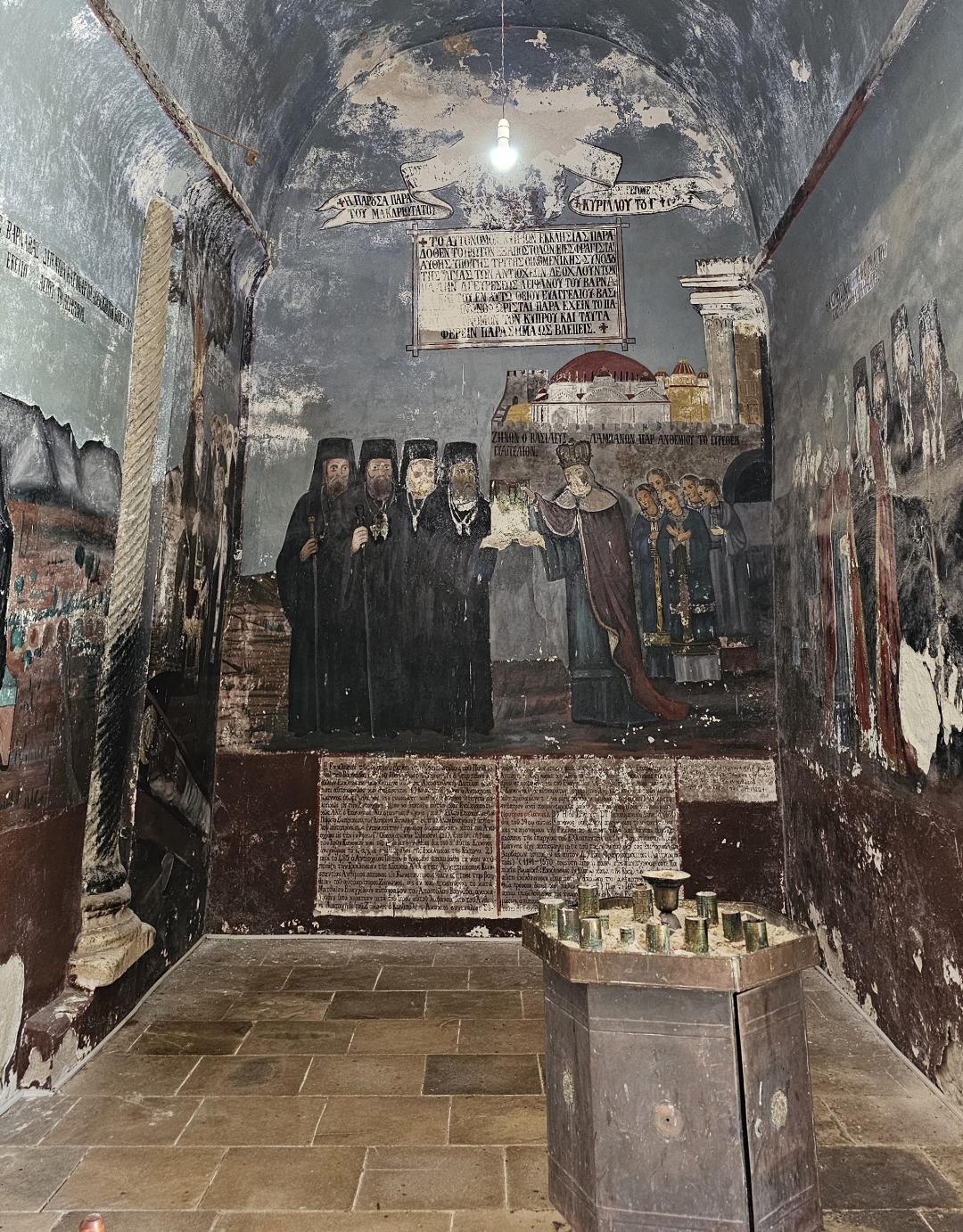
The Monastery of Saint Barnabas in its current form was built on the ruins of the Byzantine church in the 18th century. It was constructed with three domes, but due to the lack of a foundation and soft soil, one of the domes along with the apse collapsed. During repairs, the third dome was not replaced, resulting in the church acquiring an unusual square shape. Inside the church, one can see a fresco illustrating the bishop’s dream, the discovery of the body, and the presentation of the Gospel to the emperor. In 1917, monastic life in the monastery was revived by three brothers — monks Chariton, Stefan, and Barnabas. They painted the left conch of the altar with frescoes depicting the story of the discovery of the relics of Apostle Barnabas. After 1965, seven monks lived in the monastery. During the Turkish invasion of 1974, the monks were forcibly expelled from the monastery, and the church was looted. In 1991, the monastery building was restored and turned into a museum, which today houses archaeological finds. By the way, new excavations are often organized on the territory adjacent to the monastery: it is assumed that the shrine stands on an ancient Salamis necropolis. Today, the church, which no longer houses a monastic community, functions as an icon museum. The former premises also contain an archaeological museum with artifacts dating back to the Neolithic era. Besides icons, the museum holds an impressive collection of Cypriot artifacts dating from the 7th century BC. The chapel associated with the church, where the archaeological collection is now kept, contains the saint’s tomb.
The icon museum houses one of the best collections of antiquities from the Bronze and early Iron Ages in Northern Cyprus. The archaeological museum also holds relics from the nearby ancient city of Engomi, dating to the period of Ancient Egyptian influence.
Sources:
https://cyprus-faq.com/ru/north/mesta/monastyr-svyatogo-varnavy-i-muzei-ikon/
https://ru.wikipedia.org/wiki/Monastery_of_Apostle_Barnabas
http://cyprusiana.ru/index.php/towns-and-villages/north-cyprus/apostolos-varnavas-monastery.html
https://severnyi-kipr.ru/information/chto-posmotret/monastyr-grobnitsa-apostola-varnavy-famagusta/



Written by Jermaine
Discuss this with the author and others
No comments yet. Be the first to start the conversation.