

The former Latin Cathedral of Saint Nicholas is the most beautiful building in Northern Cyprus and is located in the fortress city of Famagusta. This church has a unique fate — a Christian cathedral that was forced to change its god and become a mosque. This makes the shrine even more unique; the combination of Gothic architecture and a minaret impresses and amazes — where else would you see such a thing?

This church has had many names: originally the Cathedral of Saint Nicholas, then Ayasofya Magusa or Aya Sofya "Holy Wisdom," and finally the Lala Mustafa Pasha Mosque.
In 1291, the Arabs expelled the Crusaders from Jerusalem. Completely and irrevocably. But the Crusaders did not yet know this and hoped to someday reclaim the holy city. Meanwhile, they decided to establish a strong base on Cyprus, in Famagusta, the city closest to Jerusalem.
Expecting a swift return to Jerusalem, the kings of Cyprus crowned themselves twice. The first coronation took place in the capital Nicosia with the Crown of Cyprus in the Cathedral of Saint Sophia. For the second coronation, a magnificent cathedral was built following the best examples of French Gothic cathedrals. For this purpose, under Bishop Guillaume de Beaujeu in 1298, it was decided to allocate 70,000 Byzantine gold coins. A colossal sum for those times. The entire island of Cyprus was sold by Richard the Lionheart in 1191 for 100,000.
When Guillaume de Beaujeu died 10 years after construction began, the new bishop Antonio Sarona managed to embezzle 20,000 Byzantine gold coins in a short time and was removed from office. The cathedral was built from 1298 to 1312, and the date of completion is recorded above its entrance. All subsequent rulers held ceremonies here up to Catherine Cornaro.

The cathedral's construction followed a similar design to the Reims Cathedral in Paris. Thus, the Cathedral of Saint Nicholas is also known as the "Cypriot Reims." In 1328, the cathedral was officially consecrated and was actively used by the Lusignans as the place where they were crowned as kings of Jerusalem. However, construction work continued there until about 1400.

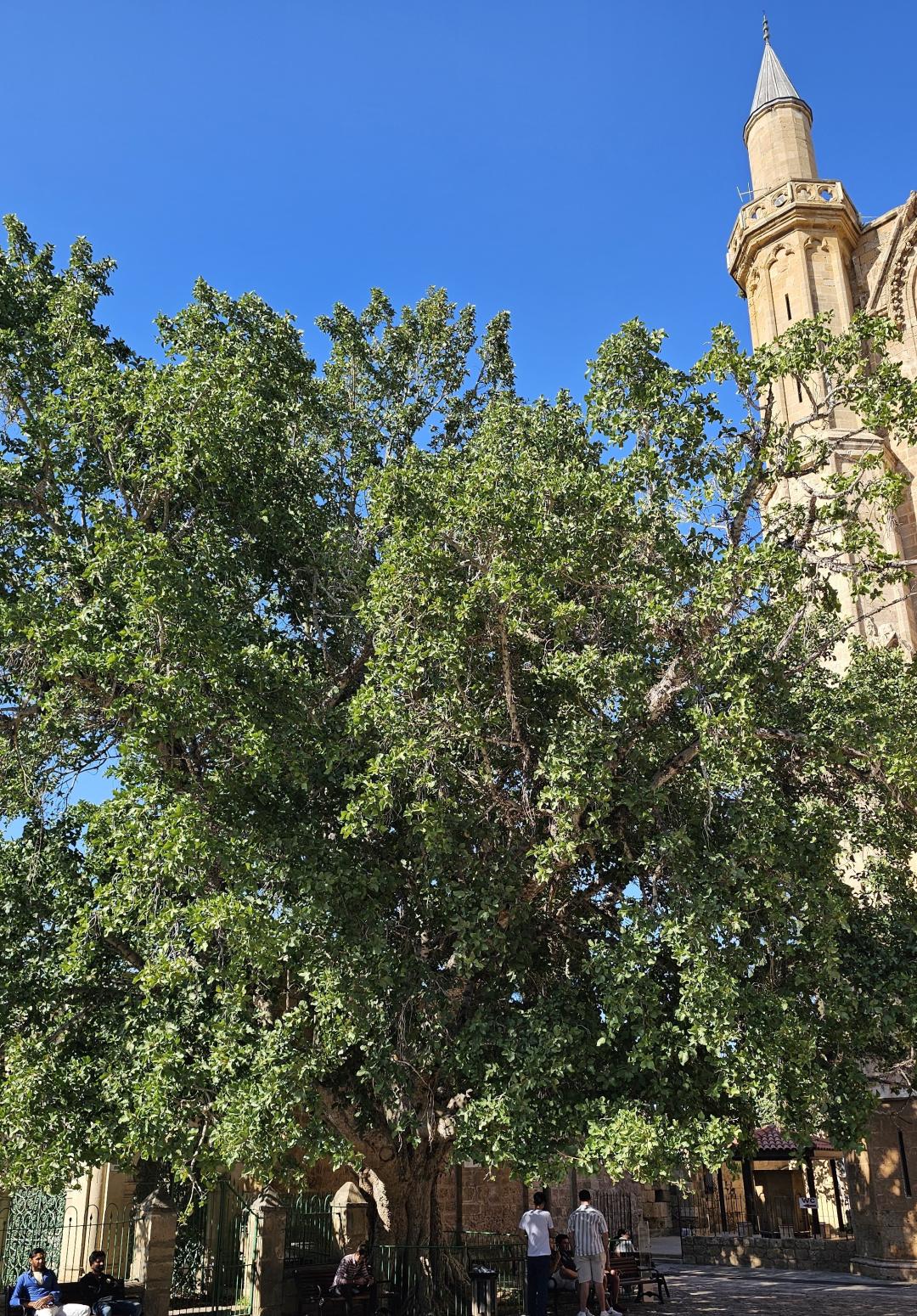
A famous fig tree grows behind the church; legend has it that it was planted simultaneously with the start of the shrine's construction. The church was built in the style of radiant Gothic, which is rare outside France (although the church was built by the French — rulers from the Lusignan dynasty, who owned Cyprus from 1192 to 1489). The Cathedral of Saint Nicholas is the main medieval church of the city of Famagusta. The cathedral almost entirely follows the laws of French Gothic, except for the three apses on the exterior volume. It seems this detail was inspired by neighboring Byzantine churches.
Besides coronations and royal weddings, the cathedral is famous for many miraculous and mysterious stories.
In the 14th century, terrible plague epidemics swept across Europe, brought from Eastern China. In 1348, 15 million people died in Europe from the disease, which was a quarter of the entire population. By 1352, 25 million had died, a third of Europe's population. The "Black Death" also ravaged Famagusta. A special envoy from the Pope was sent to the city on a special mission. A solemn service was held in the Cathedral of Saint Nicholas, after which a procession circled the entire city. Chronicles recorded that there were no cases of plague after that.
If you stand facing the cathedral, to the right are rooms specially built for coronations. In 1369, the coronation of the young King Peter I triggered the start of the Genoese war and led to countless casualties and the looting of the entire island. All subsequent rulers held ceremonies here up to Catherine Cornaro, who in 1489, after the death of her husband and only son, signed the abdication from the throne, which led to French Cyprus coming under the control of the Venetian Republic.
In 1571, during the siege of Famagusta by the Turks, the cathedral was heavily damaged by cannon fire. Most of the sculptural decoration of the church was destroyed. After the Venetians surrendered the city to the Ottoman Empire, the church was converted into a mosque and renamed Ayasofya Magusa. At that time, a minaret was added to the cathedral, which, surprisingly, fit very organically into the Gothic style. Numerous earthquakes on the island also caused significant damage to the building. For example, in 1735, a strong earthquake damaged the small towers near the bell towers, leaving only their lower sections.
In 1974, the mosque was renamed Lala Mustafa Pasha in honor of the ruthless Ottoman general and tutor of the sultan’s sons, who commanded the siege of Famagusta in 1571. It was under the walls of this cathedral that he flayed alive Marco Antonio Bragadin, the captain-general who led the defense of Famagusta.
The unique status helped the building survive during the Turkish conflict when many Christian churches were destroyed. It was once said about Famagusta that one could pray several times a day and all in new churches — just imagine, there were once 365 churches in Famagusta! Only some of the buildings have survived to this day.
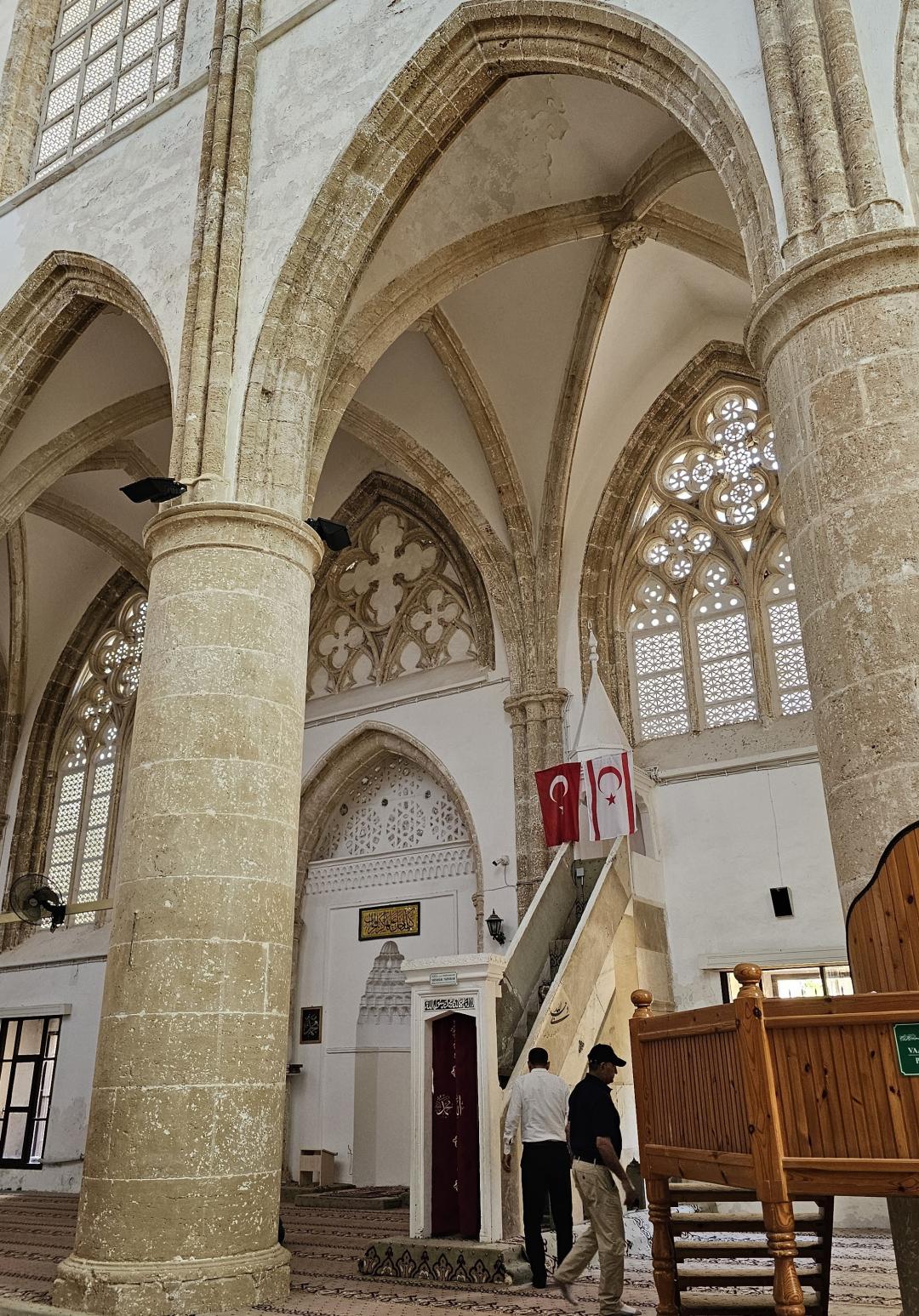
The Lala Mustafa Pasha Mosque is still an active mosque. Inside the mosque, according to Muslim practice, all images of the human form were removed, and the frescoes on the walls were covered with plaster, and who knows what treasures remain hidden beneath it. The building was very lucky — after many years, its exterior appearance remains a rare example of Gothic style. The same cannot be said for the cathedral's interior. After it was converted into a mosque, the floors were covered with carpets, the main altar was removed, a mihrab appeared, all the walls were whitewashed, and the beautiful columns that decorated the church were cleaned down to the bricks.
The Turkish military commander Lala Mustafa Pasha destroyed statues of saints and replaced stained glass with clear glass. It is reliably known that the last two rulers of Cyprus from the Lusignan dynasty — Jean II de Lusignan (also John II of Cyprus, 1418–1458) and his son Jean III, who died in infancy — were buried in the cathedral. The exception is the tomb of the Bishop of Famagusta, ordained in 1360. In 1365, while swimming in the sea, the bishop caught a severe cold, from which he later died. Today, in the cathedral, you can see a white marble slab engraved with his image. The apse of the building is decorated with a crown depicting not only the crown of Christ as King of Heaven but also the crown of the Lusignan dynasty, kings of Jerusalem.


Written by Jermaine
Discuss this with the author and others
No comments yet. Be the first to start the conversation.