

In 1836-1837, the main line of the Tsarskoye Selo Railway was laid through the territory of Pavlovsk Park. A clearing was made through the park, and an embankment was constructed almost up to Sadovaya Street. At the end, there was a platform for passengers. Later, the station was named Pavlovsk-I. The park owner, Grand Duke Mikhail Pavlovich, leased the land to the joint-stock company of the Tsarskoye Selo Railway for a fee of 20 kopecks per square sazhen, with the right to terminate the contract and the condition obliging the lessee to dismantle the buildings and restore the park-like character of the area. Approval of building projects also remained with the owner.
When von Gerstner (the railway builder) was preparing the project for the Tsarskoye Selo Railway, he primarily thought about its profitability and seriously studied the problem of future transportation. In the "Note on the benefits of building a railway from Saint Petersburg to Tsarskoye Selo and Pavlovsk," submitted for the consideration of Nicholas I on January 6, 1835, von Gerstner wrote: "At the end of the road, a new Tivoli will be arranged, a beautiful vokzal: it will serve as a gathering point for the capital's residents both in summer and winter." Initially, stations, or more precisely "vokzals," referred to pleasure gardens and parks with pavilions where masquerades, balls, and concerts were held (from the English Vauxhall — the name of the Vauxhall Gardens opened in 1660 in Kennington, near London). Since the late 18th century, such public gardens became increasingly popular in Petersburg and later throughout the Russian Empire (they opened in Saratov, Astrakhan, Kazan, Kharkov, and so on). However, the Pavlovsk vokzal became one of the most important cultural centers not only in the country but also abroad. By analogy with this famous place, main stations on new railways built across the Russian Empire began to be called vokzals. Gerstner decided to interest the capital's population in traveling by railway. To encourage people to visit the suburbs, he planned to open special hotels with buffets and restaurants at the stations in Tsarskoye Selo and Pavlovsk for resting after walks in the parks.
The popular writer of the first half of the 19th century, Nestor Kukolnik, reported with patriotic enthusiasm on May 25, 1838, a few days after the opening of the vokzal, in the "Northern Bee": "I look at the railway to Pavlovsk as at Gutenberg's first wooden letters. Railways are just as useful as printing. For me, the railway is enchantment, magical pleasure."
On March 16, 1836, the Board of the Tsarskoye Selo Railway Society announced a competition for the design of a building for a "vokzal with a hotel for the refuge and pleasure of the public," where the tired residents of the capital could get "pleasant rest and reasonable entertainment in the lap of nature of Pavlovsk Park." (Among such entertainments were balls, dances, masquerades).
A reward of 20,000 rubles in assignations was announced for the best building design. Among the 11 projects submitted by Russian and two by German architects, Grand Duke Mikhail Pavlovich chose the project by Berlin architects Stark and Stüler. But since the construction cost according to their design greatly exceeded the planned amount, the project by Stakenschneider, a Petersburg architect, was chosen.
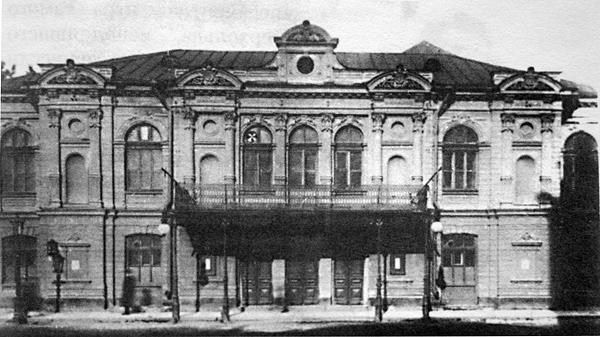
Construction of the vokzal began on July 7, 1836, and by September, the huge pavilion was roughly completed. It consisted of a round "vestibule," a hall for dinners, balls, and concerts, two small halls on the sides, and two winter gardens. The two wings contained 40 hotel rooms for guests and 12 rooms for the hotel owner and servants. The building was surrounded by a circular gallery. A special passage connected the vokzal building with the railway platform.
The Great Hall was intended to house the famous mechanical orchestra "Apollonikon," built by the English "mechanical artist" Robson. Due to bad weather, the building's finishing was delayed until the beginning of the following year.
The opening of traffic between Tsarskoye Selo and Pavlovsk was scheduled for September 27. Since the ordered locomotives had not yet arrived, it was decided to use horse traction. Hundreds of residents gathered at the appointed time in Pavlovsk Park. The entire 3.5 verst route was covered by horses in 15 minutes. Such rides continued for three Sundays. In October, two locomotives arrived from the Stephenson and Cockerill factories and one from the Hackworth factory in England. On November 6, the first trips with steam traction were scheduled. At noon, a prayer service was held near the train in Tsarskoye Selo, and the train departed for Pavlovsk. Through traffic between Petersburg and Pavlovsk was opened only on May 22, 1838.
In the fall, with the start of concerts at the Pavlovsk vokzal, the number of trains increased. On concert days, direct "musical" trains began to run, including a special carriage for costumes.
At the terminus of the railway, according to architect Stakenschneider's project, a wooden pleasure pavilion Kursal — "Voxal" — was built in 1836-1838. To attract passengers to the railway, the vokzal housed a restaurant, hotel, and music hall. Concerts for the public and park entrance were free, as Grand Duke Mikhail Pavlovich particularly insisted. The opening of the Pavlovsk Vokzal took place on May 22, 1838; near the vokzal was a small garden with fountains and a bandstand for the orchestra.
Initially, music at the vokzal was of secondary importance; it played during dinners, balls, and dances. The orchestra was located on the choir loft since there was no stage inside. A brass band played on the open-air stage in the garden. In the fall, to attract the public, the Moscow gypsy choir of Sokolov was invited. In January 1839, the famous conductor Joseph Herman arrived from Prussian Breslau with his orchestra; he was considered a student of Strauss the Elder. He performed in Pavlovsk intermittently until 1845. Petersburgers marveled at the conductor's incredible ball repertoire. "Playing every evening, he does not repeat the same piece," the press wrote.
The musical entertainments, especially cared for by the Tsarskoye Selo Railway administration, added even more magic. They were intended to attract passengers to this new mode of transport in Russia. Not limited to traditional balls and fireworks, the board constantly thought about new entertainments for a diverse audience. Part of the musical program was free. However, tickets were required for conductors' benefits, concerts of "serious" music, outstanding soloists, and charity evenings.
In January 1844, a fire broke out in the building, almost destroying it. The building was reconstructed according to Stakenschneider's project in three and a half winter months. The reopening of the restored vokzal took place on May 13, 1844.

The railway administration began inviting famous conductors, performers, and vocalists to perform. Free charity evenings attracted many summer residents from various social classes. In 1856, Johann Strauss Jr. (and his brothers) was invited to Pavlovsk; he remained conductor for ten seasons and returned as a guest artist in 1869 and 1872. Like Herman, Strauss distinguished between music for dancing and music for listening. On Thursdays, works by Beethoven, Mozart, Rossini, Wagner, Verdi, and other composers were performed. By the end of the 19th century, the "serious" line in the vokzal's programming policy prevailed over the entertaining one. Visiting conductors organized concerts of Russian music, performing works by Mikhail Glinka, Alexander Dargomyzhsky, Anton Rubinstein, Pyotr Tchaikovsky, and others.
With the invitation in 1856 of the famous "King of Waltzes," Johann Strauss Jr., whose fee of 22,000 rubles per year exceeded all previous ones, a new era began in Pavlovsk. He became the taste-maker for the Russian public for almost 15 years. The "Saint Petersburg Gazette" reported that on the very first evening "the crowd in Pavlovsk was immense," and "each piece he played stirred a genuine storm." After the performance, he was carried on shoulders all the way to his apartment. In the 1860s, the "Northern Bee" shared a witticism from a music lover: Strauss "soon will be able to walk from his apartment to the stage... on a carpet glued together from tender notes of admiring fans of his electromagnetic bow."
The main activity of the Vokzal became concerts. The restaurant now played a secondary role.
In the winter of 1860-1861, the central part of the building was redesigned: the restaurant was moved to a side wing, the hall was expanded, and a permanent stage was built. The work was carried out according to the project and under the supervision of architect Petzoldt.
The concert hall's capacity was increased to 3,000 people. A reading room and a bowling hall appeared. On the square in front of the Vokzal, an open summer stage, a gymnastics net, and a fountain (later converted into a gas lamp) were constructed.
By the 1880s, the vokzal had a separate hall for performances and its own orchestra, which sometimes included up to 80 musicians. In 1912 (the 75th anniversary of the vokzal), critic Findeisen noted that 10,500 concerts had been given there, including about 600 symphonic ones. The popularity of this musical center continued into the first half of the 20th century; it was jokingly called, as recalled by Tsarskoye Selo resident Anna Akhmatova, the "salty peasant" from the French salon de musique.
From 1892 to 1903, concerts in Pavlovsk were led by conductor Galkin. During this time, the repertoire shifted toward serious music. The orchestra grew to 100 members. In 1875-1876, according to architect Benois's project, a Summer Theater for a thousand people was built at the Vokzal.
The part of the park cut off by the railway gradually fell into neglect; clearings and lawns became overgrown. The area leased by the railway company expanded gradually. New structures were built. Only during the railway construction were 600 trees cut down.
The musical pavilion in the center of the Great Star had to be expanded. It could no longer compete with the Vokzal and was used for a time as a café.
The Vokzal became the most popular place in the city. For some time, it turned Pavlovsk into one of Petersburg's musical centers. Both light music and symphonic works by famous composers were performed here.
Many famous conductors and soloists performed at the Pavlovsk vokzal, and being invited to perform there was considered an honor. Performers included Shalyapin and Sobinov; Kschessinskaya danced, among many others.

Sources:
https://arzamas.academy/mag/912-pavlovsk
https://www.citywalls.ru/house25757.html


Written by Jermaine
Discuss this with the author and others
No comments yet. Be the first to start the conversation.