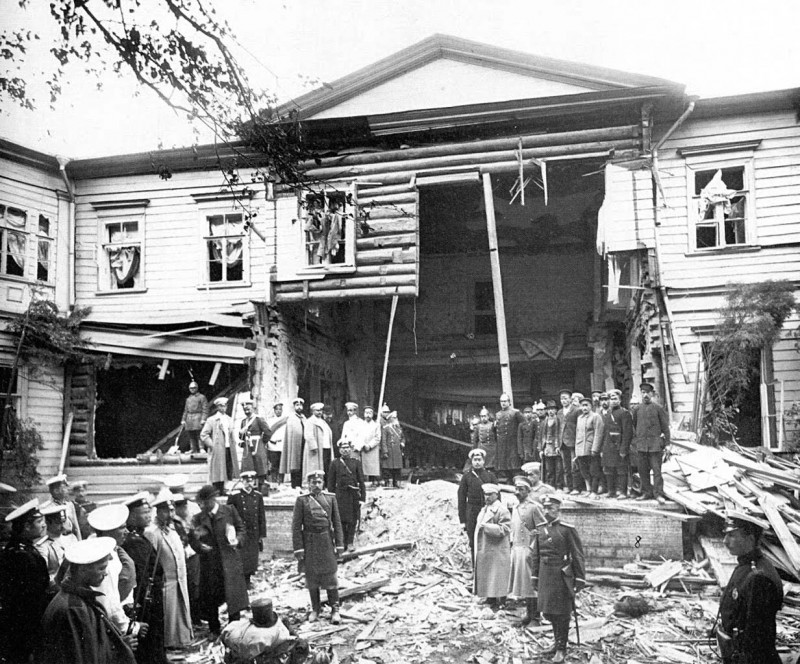

August 12 (25), 1906, fell on a Saturday; it was the reception day of the Minister of Internal Affairs of the Russian Empire, Pyotr Stolypin. On such days, anyone needing a meeting with him could visit the dacha on Aptekarsky Island, where two reception rooms on the first floor were allocated for working visits. Usually, many people of various estates and ranks gathered. The fateful day was no exception.
The assassination attempt was carried out by the St. Petersburg organization of the "Union of Socialist-Revolutionaries Maximalists," formed in early 1906. Stolypin was hated by the revolutionary part of society for his harsh suppression of the revolutionary movement. The organizer of the attempt was Mikhail Sokolov ("Bear," "Anatoly," "Pyotr Vasilyevich").
The explosive devices were made by Vladimir Lichtenstadt in the dynamite workshop of the Bolshevik "Combat Technical Group" led by Leonid Krasin, which was set up in the Moscow apartment of Alexei Peshkov (Gorky). The workshop's security was headed by Simon Ter-Petrosyan (Kamo).
"Our designed shells began to attract great attention even from the Socialist-Revolutionary militants, who generally considered themselves monopolists in the manufacture of explosive shells. These shells somehow got into the hands of the Socialist-Revolutionary Maximalists, who used them in the explosion at Stolypin's dacha. These shells were very large, each weighing about 15-16 pounds in finished form, shaped like a large flat box, convenient for carrying. To protect themselves from possible misfires at the moment of explosion, each shell had two detonators; at least one of them would reach the target. The Socialist-Revolutionaries had only three such shells. As it later turned out, only two were used; one remained unused. Nevertheless, Stolypin's dacha was blown up." wrote Sulimov in the chapter "Bomb Workshop" from the book "Combat Group under the Central Committee of the RSDLP(b)".
The terrorist group had numerous safe houses throughout all districts of Petersburg, equipped a laboratory and warehouses for weapons delivered from Finland, established its own stable with two exits, and acquired two automobiles. The group conducted active reconnaissance, attempting to establish surveillance over several high-ranking officials.
The direct perpetrators were:
Ivan Tipunkov (nickname "Grisha"). A native of Bryansk, a worker. He had been repeatedly involved in investigations of state crimes.
Ilya Zabelshansky ("Frenchman"). A native of Minsk. Until mid-1905, he lived in France. In Russia, he lived under a passport of a Belgian citizen.
Nikita Ivanov ("Fedya"). A native of Smolensk. In March 1906, he was held in the Bryansk prison on charges related to the robbery of an artel member of the Bryansk factories.
August 12 (old style), Saturday — was Stolypin's reception day at the government dacha on Aptekarsky Island in Saint Petersburg (Aptekarskaya Embankment, 6B). The reception began at 14:00. Around half past two, a landau carriage arrived at the dacha, from which two men in gendarme uniforms with briefcases in hand got out. It was their uniforms that betrayed them; the doorman and adjutant Zamyatnin noticed because the newcomers wore old helmets instead of the recently changed headgear. Moreover, they suspiciously clutched their briefcases to their chests. As soon as the "gendarmes" realized the doorman was approaching to stop them before the house, they rushed inside. On the first floor, they were met by the rushing Zamyatnin, but the criminals managed to throw their briefcases to the floor. A deafening explosion followed, injuring more than 100 people: 27 died on the spot, 33 were seriously wounded, many later died.
Two of Pyotr Arkadyevich's children (who were on the balcony) were injured — twelve-year-old daughter Natasha (both legs broken) and three-year-old son Arkady.

"Looking around in horror, I saw at the place where the door had just been, which I was about to open, a huge hole in the wall and beneath it, right at my feet, the Neva embankment, trees, and the river," wrote Stolypin's daughter Maria in her memoirs. Immediately after the explosion, continuous screams and moans filled the air. Stolypin himself, with his wife, searched for their two children, daughter Natasha and son Adyu, who were on the balcony and also injured; Natasha had both legs broken, and the three-year-old son suffered multiple bruises.
Other victims were bandaged at the scene of the tragedy by Maria and Princess Marusya Kropotkina until ambulances arrived.
The revolutionaries and those nearby, Zamyatnin and the doorman, had no chance of survival — the explosion killed them instantly.
Stolypin's dacha on Aptekarsky Island was seriously damaged. The only room untouched by the blast was the prime minister's office. "At the moment of the explosion, Papa was sitting at his desk. Despite two closed doors between the office and the place of the explosion, a huge bronze inkwell rose into the air and flew over my father's head, dousing him with ink. Nothing else in the office was damaged by the blast, and among the dozens killed and wounded in the adjacent rooms and upstairs, Papa, by God's will, remained safe and unharmed," Maria recalled the events of that day.
After the assassination attempt, Stolypin only strengthened his position as a statesman. The people saw his cold-blooded calm and self-control in a terrible situation. Shortly after the 1906 attack, the "Regulation of the Council of Ministers on Military Field Courts" was adopted, significantly shortening the trial times for those accused of assassination attempts and murders — the trial period was not to exceed 48 hours. "The state can, the state must, when it is in danger, adopt the strictest, most exceptional laws to protect itself from collapse. There are, gentlemen, fateful moments in the life of a state when state necessity stands above the law and when one must choose between the integrity of theories and the integrity of the fatherland," Stolypin declared at the II convocation of the State Duma in 1907.
Sources:
M. M. Engelhardt. Explosion on Aptekarsky Island // History of Terrorism in Russia in Documents, Biographies, Studies. Rostov-on-Don, 1996
https://ru.wikipedia.org/wiki/Explosion_on_Aptekarsky_Island
https://tverdyi-znak.livejournal.com/2653697.html
Sulimov, S. Bomb Workshop. In the book: "Combat Group under the Central Committee of the RSDLP(b)", M-L. State Publishing, 1927.


Written by Jermaine
Discuss this with the author and others
No comments yet. Be the first to start the conversation.