Latvia: Riga - History and Modernity
For Browsing
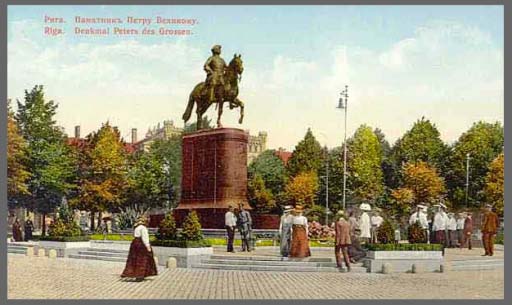
Pre-revolutionary Riga was one of the largest industrial centers in Russia, Europe, and the world. The Russian Empire developed high-tech industrial production in Riga: the Russo-Baltic Electrotechnical Plant, the telegraph factory "Provodnik," the first aviation industry in Russia, and the legendary "Russobalt" automobiles. By the beginning of the 20th century, Riga ranked fourth in the Baltic region by population after St. Petersburg, Copenhagen, and Stockholm, and seventh in the Empire — after St. Petersburg, Moscow, Warsaw, Odessa, Łódź, and Kyiv. At that time, it had a population of 282,000 people. Of these, Germans made up 47%, Russians 25%, Latvians 23%, Jews and other ethnicities 4%. New industrial enterprises continued to be established, and existing ones developed rapidly. The city's population steadily grew and reached 482,000 by 1914. The Riga industrial region became the third largest in the country by production volume — after the St. Petersburg and Moscow regions. During the Soviet era, Latvia was something like its own "little abroad" — beautiful clean city streets, mysterious names in Latin script, no shortages in stores, and beautiful girls in fashionable clothes. Vacationing in Jūrmala was then considered more prestigious than on the Black Sea coast. And the beautiful city of Riga in the Soviet years became a constant filming location for movies about "foreign life." Its elegant streets, with so many historic buildings — from medieval to Art Nouveau styles — appeared in dozens of films from those years.
 Jermaine
 Map
Loading stories…

Walks at the Residence of Kārlis Ulmanis in Dauderi (The Case of Brewer Dauder and Chemist Bingner)
Zāģeru Street 7, Northern District, Riga, LV-1005, Latvia
Latvia: Riga - History and Modernity Jermaine 
Mikhail Chekhov - from Riga to Beverly Hills
Kaļķu Street 16, Central District, Riga, LV-1050, Latvia
Latvia: Riga - History and Modernity Jermaine