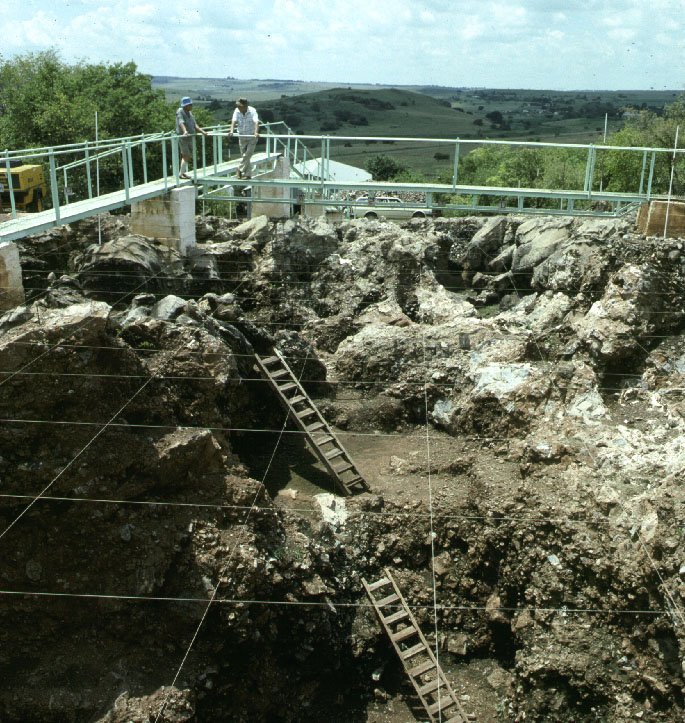

Located in the Gauteng province about 40 kilometres northwest of Johannesburg, Sterkfontein (Afrikaans for Strong Spring) is a set of limestone caves of special interest in paleoanthropology. Situated in the Muldersdrift area close to the town of Krugersdorp, the site is known as part of the Cradle of Humankind. Numerous early hominin remains have been found at the site over the last few decades, including remains attributed to Australopithecus, early Homo, and Paranthropus.
Modern excavation began in the late 1890s when limestone miners noticed fossils and brought them to the attention of scientists. In 1936, students of Professor Raymond Dart and Dr. Robert Broom began concerted excavations. The caves yielded the first adult Australopithecine, which supported Dart's claim that the Taung Child was a human ancestor. In 1947, Dr. Robert Broom found a nearly complete skull of an adult female, known as Mrs. Ples. While initially named Plesianthropus transvaalensis, Mrs. Ples is now defined as a member of A. africanus.
In 1997, Ronald J. Clarke found a nearly complete skeleton of a second species of Australopithecus, named Little Foot. This partial skeleton belongs to the species Australopithecus prometheus. While uranium-lead dating estimates the age of Little Foot at around 2.6-2.2 million years, surface exposure dating of the sediments suggests an age of approximately 4 million years. To date, finds at Sterkfontein total some 500 hominids, making it one of the richest sites in the world for early hominids.
Sources: Wikipedia, OpenStreetMap, Wikidata, Wikimedia Commons
Written by Mutabor
Discuss this with the author and others
No comments yet. Be the first to start the conversation.