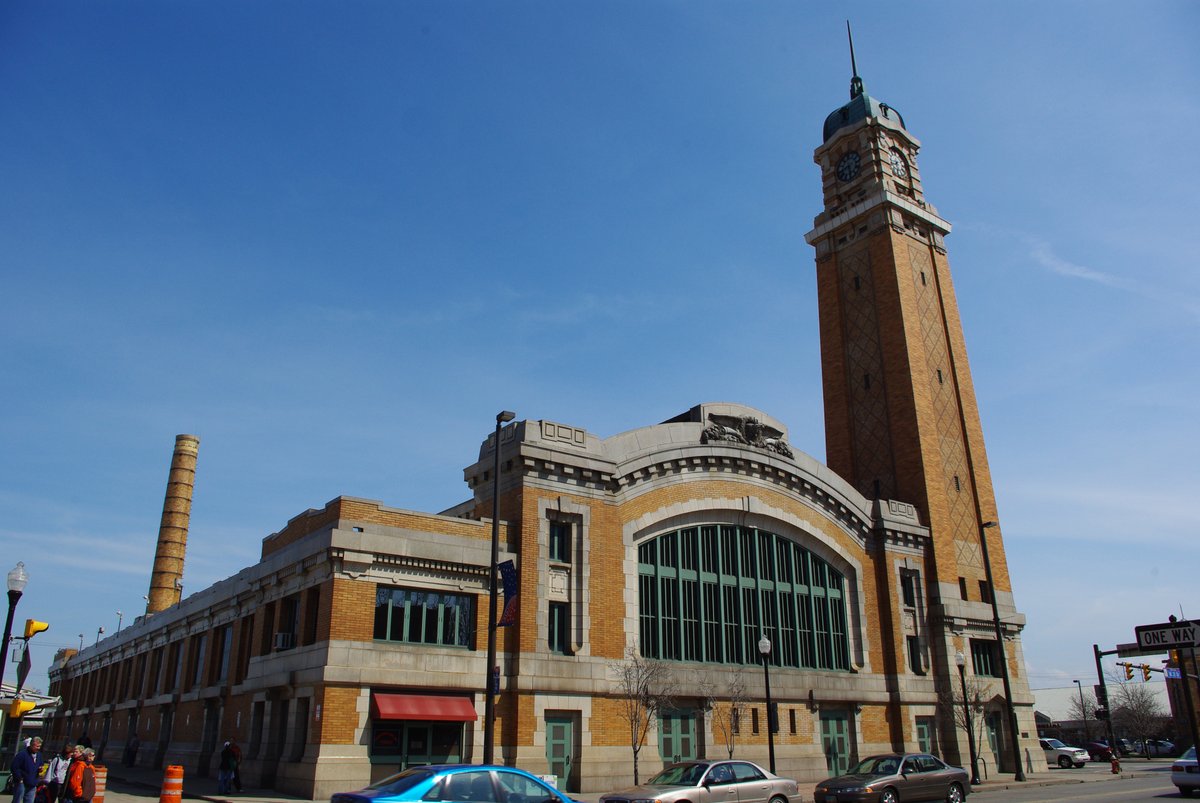
Cleveland's West Side Market began in 1840, following a land donation by Josiah Barber and Richard Lord for an open-air neighborhood market. For three decades, the market space served as a center of the Ohio City community. In 1868, a wooden-framed building was erected on the site, opening as the Pearl Street Market.
As the population grew, lands were purchased across the street in 1902 to allow for expansion. The current West Side Market building was completed in 1912 at a cost of nearly $680,000. This Neo-Classical and Byzantine brick construct features a large interior concourse with nearly 100 stalls and an 85-stall outdoor produce arcade. The building also houses a large clock tower that was easily visible from most of Ohio City in its early days.
In 1915, the West Side Market Tenants' Association was founded to help maintain the market and organize for future improvements. Significant renovations occurred in 1953 and after 1973, when the market was added to the National Register of Historic Places. In 2004, the arcade was enclosed with space heating, and major interior renovations were completed.
The market remains a diverse hub, with tenants representing various cultural backgrounds, including Irish, German, Slovene, Italian, Hungarian, Greek, Polish, Russian, and Middle Eastern descent. Named America's 'Best Food Lovers' Market' in 2010, the market's management was transferred to a non-profit board in April 2024, while the city of Cleveland retains ownership.
Sources: Wikipedia, OpenStreetMap, Wikidata, Wikimedia Commons

Written by No Other
Discuss this with the author and others
No comments yet. Be the first to start the conversation.