Egerstrasse, 1 – the first Berlin address of the poet Nabokov

Jägerstraße 1, 10117 Berlin, Germany

Egerstraße, 1 – the first Berlin address of the poet, writer, critic, and translator Vladimir Vladimirovich Nabokov. The house was not damaged and today is listed under the same number.

The Nabokov family moved from London to Berlin in early August 1920, as the writer’s father, the well-known political and public figure Vladimir Dmitrievich Nabokov, decided to establish a Russian-language newspaper, Rul’, in Berlin. He rented an apartment in the expensive Grunewald district (Charlottenburg-Wilmersdorf borough) on the first floor of a fashionable building on Egerstrasse from the widow of Dr. Raphael Levenfeld, a philologist, founder of the “Schiller Theatre Society,” and translator of L.N. Tolstoy and I.S. Turgenev, who contributed greatly to the dissemination of Leo Tolstoy’s works in Germany. Along with the apartment, the translator’s widow provided the Nabokovs with a large Russian library. The street runs from Teplitzer Strasse and Taunusstrasse through Plener Strasse. It was named in 1904 after the town located in the upper reaches of the Eger River in the Czech Republic. According to the German Nabokov researcher Dieter Zimmer, the Nabokovs rented this apartment until September 5, 1921.

In early December 1920, V.V. Nabokov came from Cambridge to Berlin for the holidays and returned to Cambridge in mid-January 1921. It was planned that he would work on translating R. Rolland’s novella Colas Breugnon into Russian (in Nabokov’s translation titled Nikolka Persik), as he had agreed with his father. However, as B. Boyd established, Nabokov left Berlin “without admitting that he had translated only 110 pages” of this book. The reason for this, not mentioned by Nabokov’s biographer, was that besides the translation, he was occupied until December 21 with composing his first Berlin poem, In the Wild North, consisting of three parts and 171 lines. The poem, imbued with émigré moods and set on a rocky northern island, was apparently inspired by a visit to the picturesque island of Schwanenwerder on the Havel River in the neighboring Charlottenburg-Wilmersdorf district of Berlin. The poem’s place of composition is noted as Grunewald, which would later become Nabokov’s favorite retreat in Berlin. The following lines from the beginning of the poem convey its mood and the gloomy island atmosphere:

My gloomy island stands like a silent grave in the wilderness.

A dreadful spring night. Fire bursts. A storm rages.

Sometimes rushing joyfully, sometimes bowing to the cliffs,

sinful waves.

In the morning, to the quiet and overcast shore

I descended the rocky path. There I loved

to dream of a fairy-tale meeting. My soul to cloud

with the evil breath of the hunchback fate had not yet managed

(Nabokov V. Poems 1918–1947. The Lament of Superman. Moscow, 2023. p. 66).

The poem was first published from the archival manuscript by Nabokov’s researcher and translator A.A. Babikov in 2023.


Sources:

https://www.domrz.ru/map/berlin/adres-semi-nabokovykh/

Boyd B. Vladimir Nabokov. The Russian Years. Biography / Translated from English by G. Lapina. St. Petersburg: Symposium, 2010.


Nabokov V. Poems 1918–1947. The Lament of Superman / Compiled, commented, translated by A. Babikov. Moscow: AST: Corpus (series “Nabokov Corpus”), 2023.

Zimmer Dieter E. Nabokov’s Whereabouts.

Follow us on social media

More stories from Great Writers: Vladimir Nabokov: "A Single Path — and Many Roads..."

Museum-Estate of V. Nabokov "Rozhdestveno"

Estate Bridge, Kiev Highway, 106, Rozhdestveno, Leningrad Region, Russia, 188356

According to Vladimir Nabokov's recollections: "The Christmas estate — purchased by him specifically for his elder son, who died young — was said to have been built on the ruins of the palace where Peter the Great, a master of dreadful tyranny, imprisoned Alexei. Now it was a charming, extraordinary house. After nearly forty years, I can easily recall both the overall impression and the details in my memory: the marble checkerboard floor in the cool and resonant hall, the heavenly overhead light, the white galleries, a sarcophagus in one corner of the living room, an organ in another, the vivid scent of greenhouse flowers everywhere…"

**“The Only Home in the World” by Vladimir Nabokov**

Bolshaya Morskaya St., 47, Saint Petersburg, Russia, 190000

The district of Bolshaya and Malaya Morskaya Streets is one of the oldest in the city on the Neva. It was there, at house number 47 on Bolshaya Morskaya Street, that the writer Vladimir Nabokov was born and lived in April 1899. Even after leaving Russia, he called this place the only home in the world for the rest of his life. The district of Bolshaya and Malaya Morskaya Streets is one of the oldest in the city on the Neva.

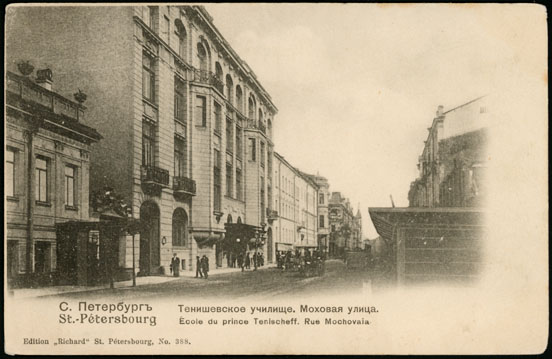
Tenishev School

Mokhovaya St., 33, Saint Petersburg, Russia, 191028

In January 1911, Vladimir Dmitrievich Nabokov enrolled his sons — the elder was almost twelve, and the younger was eleven — in the Tenishev School, a private school founded in 1900 by Prince Vyacheslav Tenishev, who, during the first few years of its existence, allocated more than a million rubles for its needs.

The Murder of Nabokov (the Father) in Berlin

Bernburger Str. 35, 10963 Berlin, Germany

On March 28, 1922, in the hall of the Berlin Philharmonic, two Russian émigré monarchists attempted to kill a Russian émigré anti-monarchist, the leader of the Kadet party, Pavel Milyukov. Milyukov survived, but his party comrade Vladimir Dmitrievich Nabokov, the father of the Russian writer Vladimir Nabokov, was killed.

Nabokov in Berlin, house 22 on Nestorstraße, Berlin

Nestorstraße 22, 10709 Berlin, Germany

A writer, poet, critic, translator, and entomologist Vladimir Vladimirovich Nabokov, who lived permanently in Berlin from June 1922 to January 1937, changed many rented apartments and boarding houses during those years. After his marriage in 1926 to Vera Evseevna Slonim, the longest and most stable period of residence was with his wife and son Dmitri in an apartment at the address: Nestorstrasse, 22.

Egerstrasse, 1 – the first Berlin address of the poet Nabokov

Jägerstraße 1, 10117 Berlin, Germany

Egerstraße, 1 – the first Berlin address of the poet, writer, critic, and translator Vladimir Vladimirovich Nabokov. The house was not damaged and today is listed under the same number.

Berlin January 31 to August 28, 1924

Keithstraße 14, 10787 Berlin, Germany

Vladimir settled at 21 Lutershtrasse in Schöneberg, at the Andersen boarding house. Lutershtrasse no longer exists. It was a continuation of today's Marin-Luther-Straße, partially corresponding to today's Keithstraße.

The estate "Vyrskaya Myza" or Nabokov's Vyra on the bank of the Oredezh River.

Parkovaya St., 26, Rozhdestveno, Leningrad Region, Russia, 188356

The estate of Vladimir Nabokov's parents. Currently, only a glacier, a park alley, and Mount Parnassus remain of the estate. The manor house burned down during the war.

The main estate of the Nabokovs - the Batovo manor

8W95+JJ Batovo, Leningrad Oblast, Russia

The main estate of the Nabokovs was the Batovo manor. Since 1800, the estate belonged to the Ryleev family; the famous poet and revolutionary Kondraty Ryleev and his friends often visited here. During Nabokov's time, the house even had a "ghost room" — a former study where the shadow of the executed poet was said to appear, and the main park alley was called the "Hanged Man's Alley" — also in memory of the former owner.

Death and Funerals

Av. Rambert 28, 1815 Montreux, Switzerland

The writer is buried in the cemetery in the village of Clarens near Montreux, on the shore of Lake Geneva.