The main estate of the Nabokovs - the Batovo manor

8W95+JJ Batovo, Leningrad Oblast, Russia

The main estate of the Nabokovs was the Batovo manor. Since 1800, the estate belonged to the Ryleev family; the famous poet and revolutionary Kondraty Ryleev and his friends often visited here. During Nabokov's time, the house even had a "ghost room" — a former study where the shadow of the executed poet was said to appear, and the main park alley was called the "Hanged Man's Alley" — also in memory of the former owner.

The village of Batovo on the bank of the Oredezh River was granted by Paul I to Major General P.F. Malyutin, a former officer of the Gatchina troops. In 1800, Malyutin gifted Batovo to the mother of the poet-Decembrist Ryleev, Anastasia Matveevna. After her death in 1824, Ryleev became the owner of Batovo; his comrades from the Northern Society visited him here. While imprisoned awaiting his sentence, Ryleev arranged to sell the estate (900 desyatinas and 60 serfs) to pay off debts, which was only done in 1827. From 1854, the estate belonged to the Korf barons, under whom a new wooden house with a belvedere was built and the park was significantly expanded. Batovo is reflected in the works of Nabokov, who visited the estate of his grandmother Maria Ferdinandovna, née Korf.

The main nest of the Nabokovs was the Batovo estate. Since 1800, the estate belonged to the Ryleev family; the famous poet and revolutionary Kondraty Ryleev and his friends often visited here. It is known for certain that Ryleev was here in 1824, together with his friend Alexander Bestuzhev. There is a quote from Alexander describing Batovo: “The location there is wonderful… A quiet river winds between steep wooded banks, where it widens into a pool, where it undercuts rocks from which clear streams run down. Silence and wildlife all around, and I spent five days outdoors, in the forest, by the river.”

In Nabokov’s time, the house even had a “ghost room” — a former study where the shadow of the executed poet supposedly appeared, and the main alley of the park was called the “Hanged Man’s Alley” — also in memory of the former owner.

Batovo was acquired in the mid-19th century by the writer’s great-grandmother, Baroness Nina Alexandrovna Korf, who in her old age moved back to her homeland, Samara, selling the estate to her daughter Maria Ferdinandovna Korf and her husband Dmitry Nikolaevich Nabokov. They had several children, including Vladimir, the writer’s father.


Vladimir Nabokov in Batovo. Summer 1909

In 1904, Dmitry Nikolaevich died, and only the grandmother remained in Batovo, to whom numerous grandchildren came for the summer. Sergey Nabokov, the writer’s cousin, recalled: “Maria Ferdinandovna built herself a separate small house diagonally from the entrance, where she lived as a matriarch among her beloved furniture, porcelain, and dogs, only visiting the offspring in the old house…”

Peasants wove legends about the mistress of the estate: how the baroness bathed in the Oredezh until the ice formed, how she slept with the windows open all year round, how she shot at wolves that came too close to the house.

In 1914, Batovo was sold to the joint-stock company “Stroitel,” which established a sawmill here.

Besides the main manor house and the separate house added for M.F. Korf, the park had numerous outbuildings and services, a stable, a carriage house, and a shed with a refrigerator.

After the revolution, a local club was set up in the Batovo estate; in 1925, the house burned down.


Part of the park has survived to the present day, where in 1970 a stele with a bas-relief of Ryleev was installed.


Sources:

http://nabokov.gatchina3000.ru/museum/rojdestveno_batovo_vyra.htm

http://enclo.lenobl.ru/object/1803554286?lc=ru

https://lubelia.livejournal.com/1551173.html


Follow us on social media

More stories from Great Writers: Vladimir Nabokov: "A Single Path — and Many Roads..."

Museum-Estate of V. Nabokov "Rozhdestveno"

Estate Bridge, Kiev Highway, 106, Rozhdestveno, Leningrad Region, Russia, 188356

According to Vladimir Nabokov's recollections: "The Christmas estate — purchased by him specifically for his elder son, who died young — was said to have been built on the ruins of the palace where Peter the Great, a master of dreadful tyranny, imprisoned Alexei. Now it was a charming, extraordinary house. After nearly forty years, I can easily recall both the overall impression and the details in my memory: the marble checkerboard floor in the cool and resonant hall, the heavenly overhead light, the white galleries, a sarcophagus in one corner of the living room, an organ in another, the vivid scent of greenhouse flowers everywhere…"

**“The Only Home in the World” by Vladimir Nabokov**

Bolshaya Morskaya St., 47, Saint Petersburg, Russia, 190000

The district of Bolshaya and Malaya Morskaya Streets is one of the oldest in the city on the Neva. It was there, at house number 47 on Bolshaya Morskaya Street, that the writer Vladimir Nabokov was born and lived in April 1899. Even after leaving Russia, he called this place the only home in the world for the rest of his life. The district of Bolshaya and Malaya Morskaya Streets is one of the oldest in the city on the Neva.

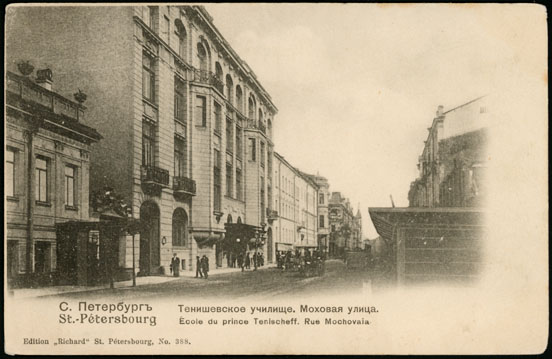
Tenishev School

Mokhovaya St., 33, Saint Petersburg, Russia, 191028

In January 1911, Vladimir Dmitrievich Nabokov enrolled his sons — the elder was almost twelve, and the younger was eleven — in the Tenishev School, a private school founded in 1900 by Prince Vyacheslav Tenishev, who, during the first few years of its existence, allocated more than a million rubles for its needs.

The Murder of Nabokov (the Father) in Berlin

Bernburger Str. 35, 10963 Berlin, Germany

On March 28, 1922, in the hall of the Berlin Philharmonic, two Russian émigré monarchists attempted to kill a Russian émigré anti-monarchist, the leader of the Kadet party, Pavel Milyukov. Milyukov survived, but his party comrade Vladimir Dmitrievich Nabokov, the father of the Russian writer Vladimir Nabokov, was killed.

Nabokov in Berlin, house 22 on Nestorstraße, Berlin

Nestorstraße 22, 10709 Berlin, Germany

A writer, poet, critic, translator, and entomologist Vladimir Vladimirovich Nabokov, who lived permanently in Berlin from June 1922 to January 1937, changed many rented apartments and boarding houses during those years. After his marriage in 1926 to Vera Evseevna Slonim, the longest and most stable period of residence was with his wife and son Dmitri in an apartment at the address: Nestorstrasse, 22.

Egerstrasse, 1 – the first Berlin address of the poet Nabokov

Jägerstraße 1, 10117 Berlin, Germany

Egerstraße, 1 – the first Berlin address of the poet, writer, critic, and translator Vladimir Vladimirovich Nabokov. The house was not damaged and today is listed under the same number.

Berlin January 31 to August 28, 1924

Keithstraße 14, 10787 Berlin, Germany

Vladimir settled at 21 Lutershtrasse in Schöneberg, at the Andersen boarding house. Lutershtrasse no longer exists. It was a continuation of today's Marin-Luther-Straße, partially corresponding to today's Keithstraße.

The estate "Vyrskaya Myza" or Nabokov's Vyra on the bank of the Oredezh River.

Parkovaya St., 26, Rozhdestveno, Leningrad Region, Russia, 188356

The estate of Vladimir Nabokov's parents. Currently, only a glacier, a park alley, and Mount Parnassus remain of the estate. The manor house burned down during the war.

Death and Funerals

Av. Rambert 28, 1815 Montreux, Switzerland

The writer is buried in the cemetery in the village of Clarens near Montreux, on the shore of Lake Geneva.