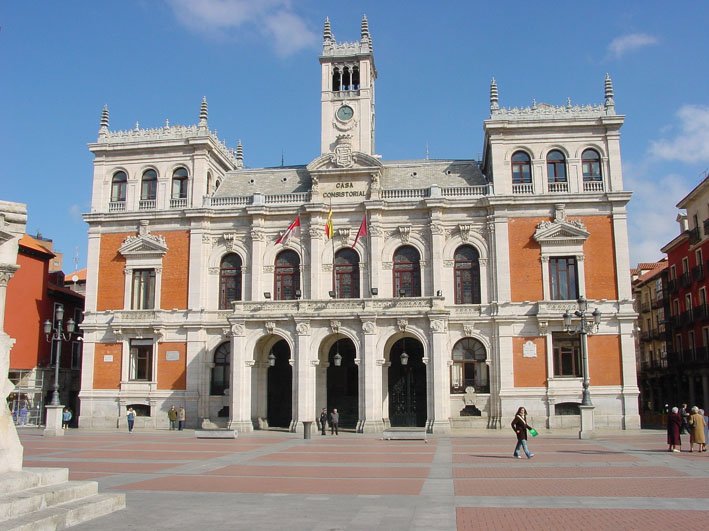

We must look closely at the facade of the Ayuntamiento de Valladolid to understand the weight of history. There, 53 visible bullet impacts remain as a permanent record of the military uprising on 18, 1936. These scars are specifically clustered around the window of the office once held by the socialist mayor, Antonio García Quintana, during the intense fighting in the Plaza Mayor.
To appreciate this structure, we should investigate its long journey toward completion. Following the demolition of the previous town hall in 1879, the city spent decades striving to construct a replacement. Although work started in 1893, it stalled because of financial disagreements and the passing of the first architect. A lottery eventually chose a new designer, resulting in the masterpiece we explore today.
Architect Enrique María Repullés y Vargas won the right to design this space, drawing inspiration from the Palacio de Monterrey. He chose granite from Campaspero and Villanubla for the base while using pressed brick for the main walls. The building spans a rectangular floor plan of 2,598 square meters across four levels, featuring a central clock tower by Moisés Arroyo.
Inside, we find a grand historicist ambition expressed through imperial stairs of marble and bronze along with original paintings by Gabriel Osmundo Gómez. This building continues to function as the administrative heart of the city.
Sources: Wikipedia, OpenStreetMap, Wikidata, Wikimedia Commons
Written by Nik Frost
Discuss this with the author and others
No comments yet. Be the first to start the conversation.