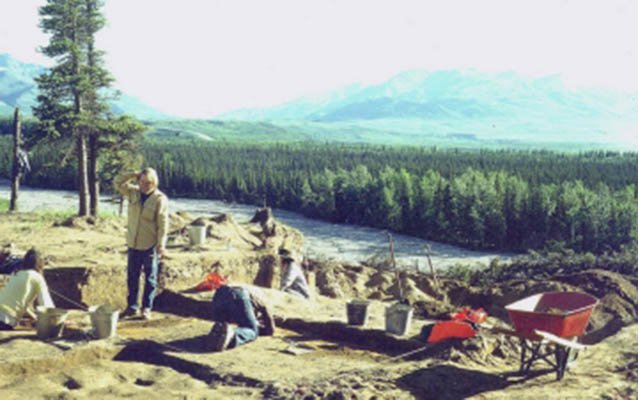

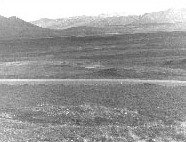
Located on the northern flanks of the Alaska Range near Healy, the Dry Creek Archeological Site sits in the Nenana River watershed just outside Denali National Park and Preserve. The site consists of an outwash terrace overlooking Dry Creek, where stratified layers of loess separate four major components. These remains have yielded evidence of human occupation as far back as 11,000 years ago.
The site includes a variety of stone tools and remains of animal processing. One of the more prominent finds is a stone scraping tool with a triangular head, measuring 31 by 16 millimetres. The youngest component, dating to 2600–1400 BCE, is one of the few places in the Alaskan interior where notched projectile points have been found. The two oldest components date to 8,500–9,000 BCE and include assemblages of microblade stone technology.
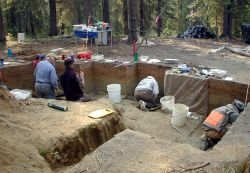
The bottom layer of the site yielded a collection of more than 3,500 artifacts, primarily stone flakes. This site is valuable for the insight it provides into the critical transitional period at the end of the most recent Ice Age. First discovered by C. E. Holmes in 1973, the site underwent major excavations in the late 1970s and further research in the 1990s.
Recognized for its historical significance, the site was listed on the National Register of Historic Places in 1974 and declared a National Historic Landmark in 1978. It remains a key location for understanding the early human history of the Alaskan interior.
Sources: Wikipedia, OpenStreetMap, Wikidata, Wikimedia Commons

Written by Friendly Jane
Discuss this with the author and others
No comments yet. Be the first to start the conversation.