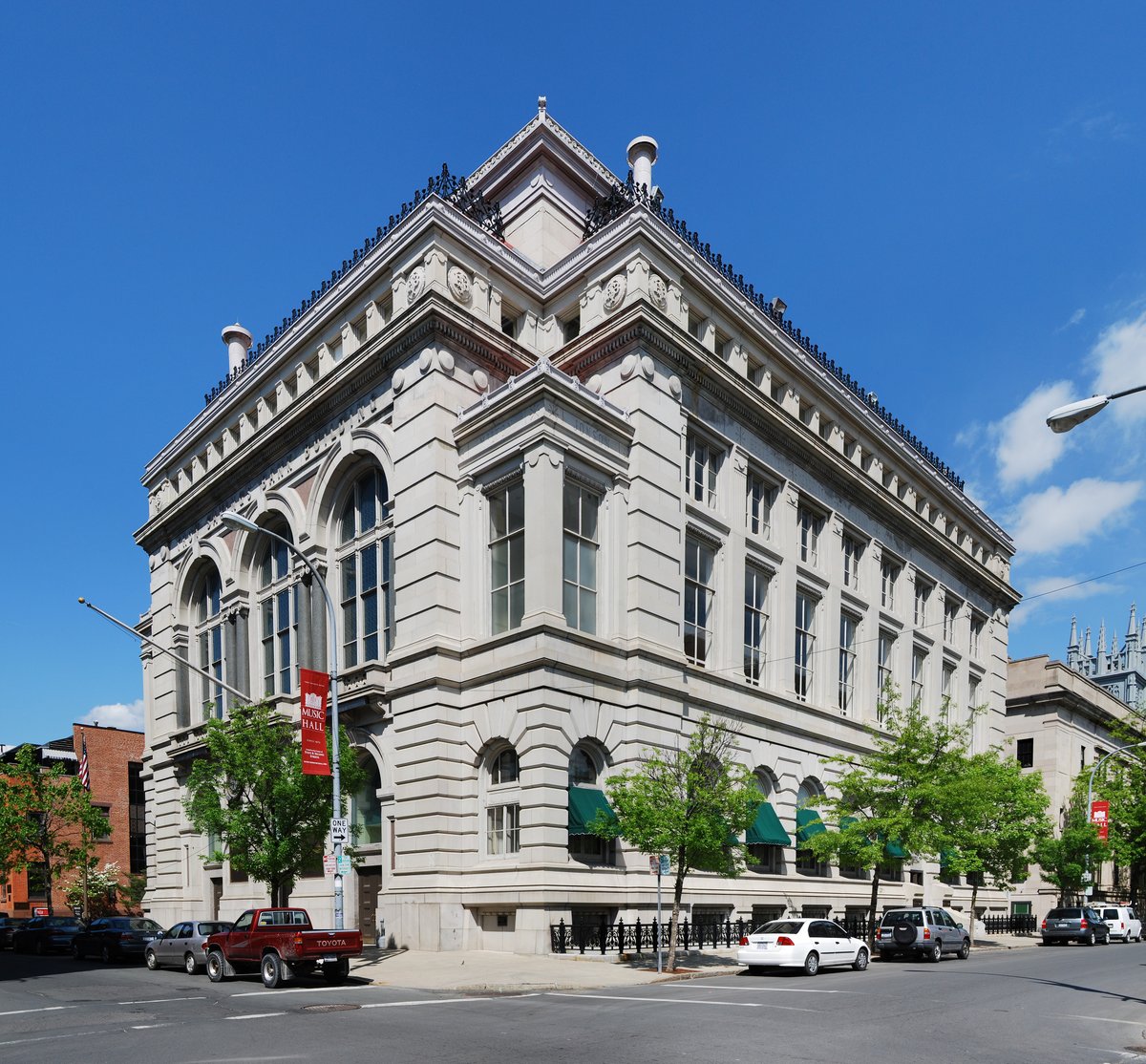
From a bank to a performance space - the Troy Savings Bank was founded in 1823 and moved to its current location in 1870. In appreciation of the community's support, the plans for the new building called for a music hall to be built on the upper floors. Completed in April 1875, the massive six-story edifice reflects the Beaux Arts and French Renaissance styles of architect George B. Post, who studied under Richard Morris Hunt.
Post's design was selected because his pioneer work in crafting metal to simulate stone in a building's superstructure was the only estimate to fall within the board's projected budget. The music hall is a performance space renowned for its acoustics and an Odell concert organ. In the early 20th century, it featured performances from artists such as Lillian Nordica, Sergei Rachmaninoff, and Jose Iturbi. In the 1930s and 1940s, artists including Vladimir Horowitz and Artur Rubinstein played there. It was a usual stop for a musician on a tour around America.
Following World War II, Troy's wealth declined and so did the bank's. Many public initiatives were begun to save the bank from closure, including ideas to establish an industrial and folk art museum downstairs and renting the Hall to the area's many colleges. In 1979, the Troy Savings Bank Music Hall Revitalization Committee was founded by private citizens. This led to the formation of the Troy Savings Bank Music Hall Corporation, a not-for-profit organization which still leases the Hall from the bank. The corporation began its ownership with a performance by the Benny Goodman Band in 1980. In 1999, the Troy Savings Bank converted to a public corporation.
Today, the music hall remains an acoustically sensitive space used for concerts and recordings. Factors contributing to its sound include the narrow shoebox form, early sidewall reflections, a tall ceiling, and thick plaster surfaces. The organ, originally installed in 1890, was restored to playable condition in 2006. The hall continues to stand as a contributing property to the Central Troy Historic District, preserving its 1,253 seats and ornate interior.
Sources: Wikipedia, OpenStreetMap, Wikidata, Wikimedia Commons


Written by No Other
Discuss this with the author and others
No comments yet. Be the first to start the conversation.