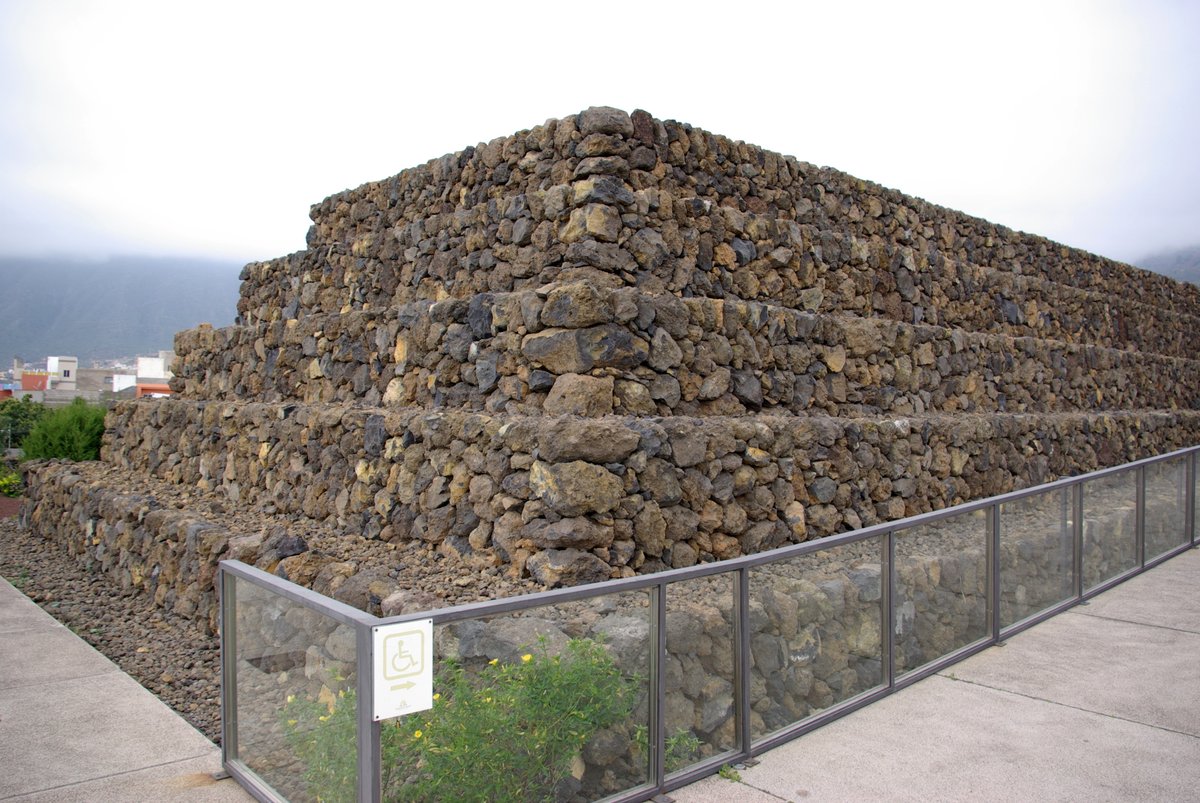

In the district of Chacona, part of the town of Güímar on the island of Tenerife, Canary Islands, Spain, lie six rectangular pyramid-shaped, terraced structures. Built from lava stone without the use of mortar, these pyramids stand as high as 12 metres. They are dated to the 19th century AD and were constructed as part of the lucrative exploitation of cochineal.
The long sides of some terrace structures mark the direction of the solstices. The main limiting wall points to the sunset on the Summer solstice, while the pyramids have stairs on their western side facing the direction of the rising sun on the Winter solstice. On the day of the Summer solstice, it is possible to experience a double sunset from the platform of the largest pyramid, as the sun sets behind a mountain top, emerges again, and sets a second time behind a neighbouring peak.
While many theories have been debated, including links to pre-Hispanic civilizations and ancient Egypt, archaeological research indicates the structures were created by the 19th-century rural population. These people were clearing cultivatable land of stones and piled them into these terrace shapes. While a natural lava cave with Guanche artefacts lies beneath the structures, the pyramids themselves were built long after that period.
Sources: Wikipedia, OpenStreetMap, Wikidata, Wikimedia Commons

Written by Mutabor
Discuss this with the author and others
No comments yet. Be the first to start the conversation.