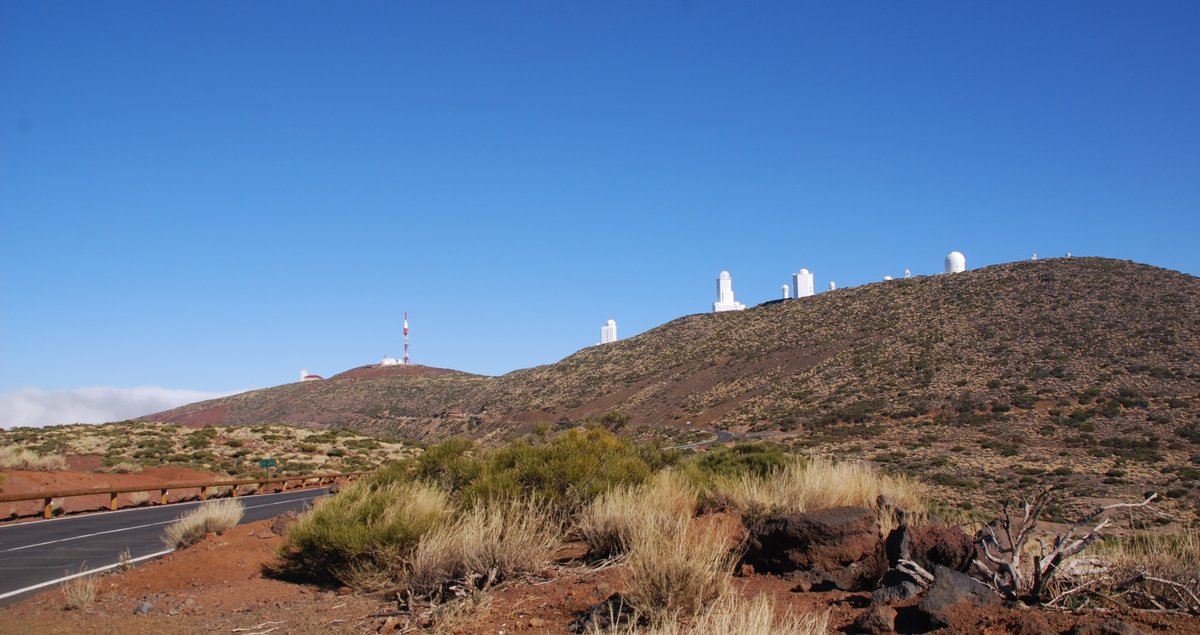

The Teide Observatory is located on Mount Teide at 2,390 metres in Tenerife, Spain. Operated by the Instituto de Astrofísica de Canarias since 1964, it became one of the first major international observatories. It attracted telescopes from around the world because of its good astronomical seeing conditions, though the emphasis for optical telescopes later shifted more towards the Roque de los Muchachos Observatory on La Palma.
The site houses a wide range of instruments for different types of observation. Solar telescopes include the 70 cm Solar Vacuum Tower Telescope, the 90 cm THEMIS, and the 1.5 m GREGOR. For nocturnal studies, the facility hosts the Carlos Sánchez Infrared Telescope, which has been installed since 1971, as well as the 80 cm IAC-80 Telescope and the 1 m OGS Telescope. Robotic telescopes like STELLA, COAST, and the Bradford Robotic Telescope for educational use allow for autonomous surveys of the sky.
Radio telescopes are also stationed here to study the cosmic microwave background, including the 33 GHz interferometer and the GroundBIRD experiment. The observatory has been the site of significant discoveries, such as the publication of the first brown dwarf, Teide-1, in 1995. The facility also hosts a visitors' centre, a residencia for astronomers, and a building constructed by Brian May to study interplanetary dust.
The climate on Mount Teide is reminiscent of southern England, with average summer temperatures around 23 °C and potential light frosts in winter. Despite the high altitude, marine features keep temperatures below 30 °C even during heat waves. This environment provides a useful observing time of 78% with median seeing measurements of 0.76" and 0.70" at sites near the Carlos Sánchez Telescope.
Sources: Wikipedia, OpenStreetMap, Wikidata, Wikimedia Commons
Written by Mutabor
Discuss this with the author and others
No comments yet. Be the first to start the conversation.