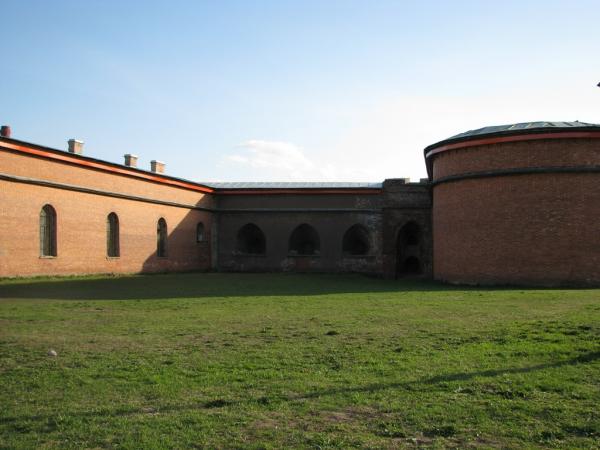
The western bastion of the fortress, defending the approaches from the Kronverksky Strait, is named after Nikita Zotov. To the east, this bastion is connected to the Nikolskaya curtain, and the Vasilievskaya curtain links the Zotov bastion with the Trubetskoy bastion.
Nikita Moiseevich Zotov was the first tutor of Tsarevich Peter. Moreover, Zotov took his teaching exam not with just anyone, but with Simeon Polotsky himself. However, the teacher approached the task innovatively. In addition to teaching literacy and reading the Psalter, he boldly introduced "Amusing books with tricks" (illustrations) into the curriculum. Perhaps this explains Peter’s love for various, sometimes peculiar amusements. The tsar truly loved Nikita Moiseevich and affectionately called him "uncle." Zotov was part of the famous Most Jestful, Most Drunken, and Most Mad Assembly. In this blasphemous company, Peter was called the Most Holy Protodeacon, while Nikita Moiseevich held the more significant title of "Archbishop of Pressburg, all of Yauza, and Patriarch of all Kokuy." In the year the fortress was founded on Hare Island, Zotov was in charge of the Tsar’s Near Campaign Chancellery and tried to help with the construction of his bastion as much as he could. But after 10 years, at the age of 70, Zotov completely lost his mind. The count decided to marry the widow of Captain Stremoukhov — Anna. Peter initially did not want to indulge this eccentricity, but eventually, why not. The jester’s wedding of the senile old man was celebrated in fitting style. Zotov did not live to see the completion of the fortress; he died in 1718. But Peter’s amusement did not end there. The tsar forced the new patriarch of the Most Jestful Assembly — Nikita Buturlin — to marry Zotov’s widow.
The wooden-earth bastion was built in 1703; between 1707 and 1709, the right part of the bastion was rebuilt in stone. From 1727 to 1729, by the personal decree of Peter II and under the direction of B. Kh. Minikh and D. Trezzini, the remaining parts of the bastion were reconstructed. It is a defensive structure of pentagonal shape with two front walls — facades — and two side walls — flanks, designed for frontal and flanking fire. A stone ramp — a slope — for raising guns and ammunition onto the fortress wall was built in 1752. Between 1832 and 1834, according to a project by engineer K. I. Opperman, the outer walls were re-faced with bricks and plastered to look like granite. Until the end of the 18th century, the combat casemates of the bastion served as warehouses. Additionally, the bastion housed the services of the Garrison and Secret Chanceries, and its rooms were used as solitary confinement cells until the mid-19th century. Furthermore, it contained workshops and a forge for the fortress Engineering team, the archive of the Main Treasury, the archive of the Provisions Expedition, and later an artillery armament warehouse. At the beginning of the 20th century, there was a fortress sundries shop and workshops of the engineering team.
Sources:
https://wikimapia.org/9606541/ru/place
https://izi.travel/ru/270c-zotov-bastion/ru
http://www.world-art.ru/architecture/architecture.php?id=2540