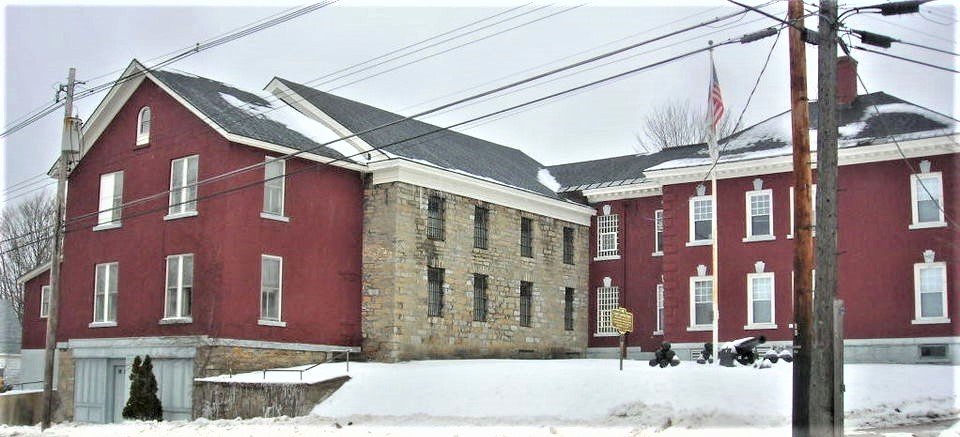

The Fulton County Jail, previously known as the Tryon County Jail, is a historical gem nestled at the intersection of Perry and Montgomery Street in Johnstown, New York. Built in 1772-1773, the site was chosen for its high ground to provide a defensive advantage. The thick walls were designed to deflect most artillery, and at the time, it was thought to be one of the strongest defensive positions in colonial America.
During the Revolutionary War, the site became Fort Johnstown, serving as a military garrison and prison to prevent enemy infiltration along the Sacandaga road. It was inspected by Lafayette in 1778. In 1781, it served as a base for 400 militiamen led by Col. Marinus Willet and Capt. John Littel, who harassed a British force of 700 Loyalists and Native Americans. George Washington also visited the fort during his tour of the Mohawk Valley in 1783.
The original building is a simple five bays wide, two bays deep, stone building with a medium pitched gable roof. The complex now features an L-shaped building with a large brick wing and a smaller brick wing dating to about 1890. The larger wing, known as the sheriff's quarters, is a two-story, square block in the Colonial Revival style.
History was made on the property when Elizabeth Van Valkenburgh was executed there on January 24, 1846, after poisoning her husband's rum with arsenic. The building remained an active jail until the 1970s and was listed on the National Register of Historic Places in 1981. Today, the building houses the Fulton County Personnel and Planning Departments.
Sources: Wikipedia, OpenStreetMap, Wikidata, Wikimedia Commons

Written by Friendly Jane
Discuss this with the author and others
No comments yet. Be the first to start the conversation.