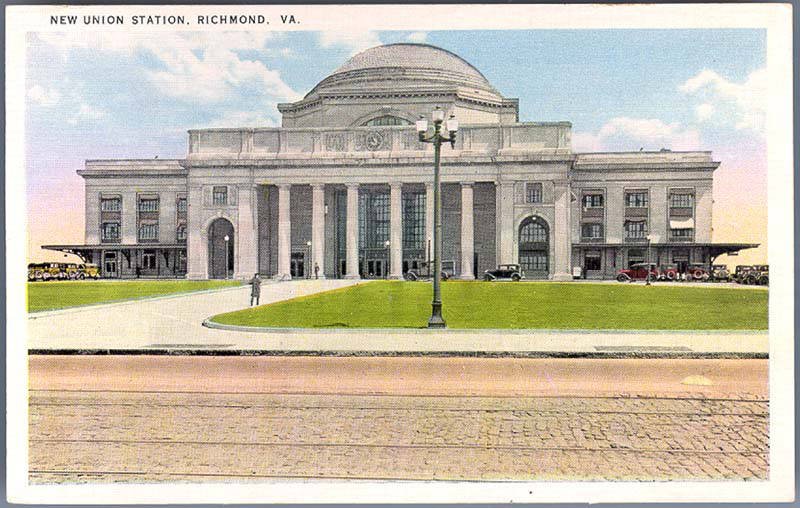
Imagine trying to build a massive railroad hub and having your contractor go bankrupt mid-job because of a world war. That was the reality for Broad Street Station. Plans were finalized in 1916, but work ground to a halt in 1917. By the time it opened in 1919, the bill had tripled from the original million-dollar estimate.
Before this building existed, Richmond's rail logic was a logistical nightmare. If you wanted to switch lines, you had to haul your luggage in a wagon between different depots. To fix this, they eventually built a connection line in 1866. They called the stop "Elba," naming it after a plantation that was itself named after the island where Napoleon was dumped in 1814. At the time, the distance from Richmond was much further than the present day.
John Russell Pope won the design competition in 1913. This was his first commercial project, so the pressure was on. He was assisted in his efforts by Harry Frazier, the chief engineer of the Chesapeake and Ohio Railway. The station features a balloon loop, allowing trains coming in from the north to pull in and then loop around to return north.
The station saw its peak during World War II, averaging 57 trains a day. It survived long enough to see the rise of Amtrak in 1971, serving trains like the Silver Meteor. Passenger service finally packed up in 1975. The building is currently used by the Science Museum of Virginia.
Sources: Wikipedia, OpenStreetMap, Wikidata, Wikimedia Commons
Written by Kyle McLonely
Discuss this with the author and others
No comments yet. Be the first to start the conversation.