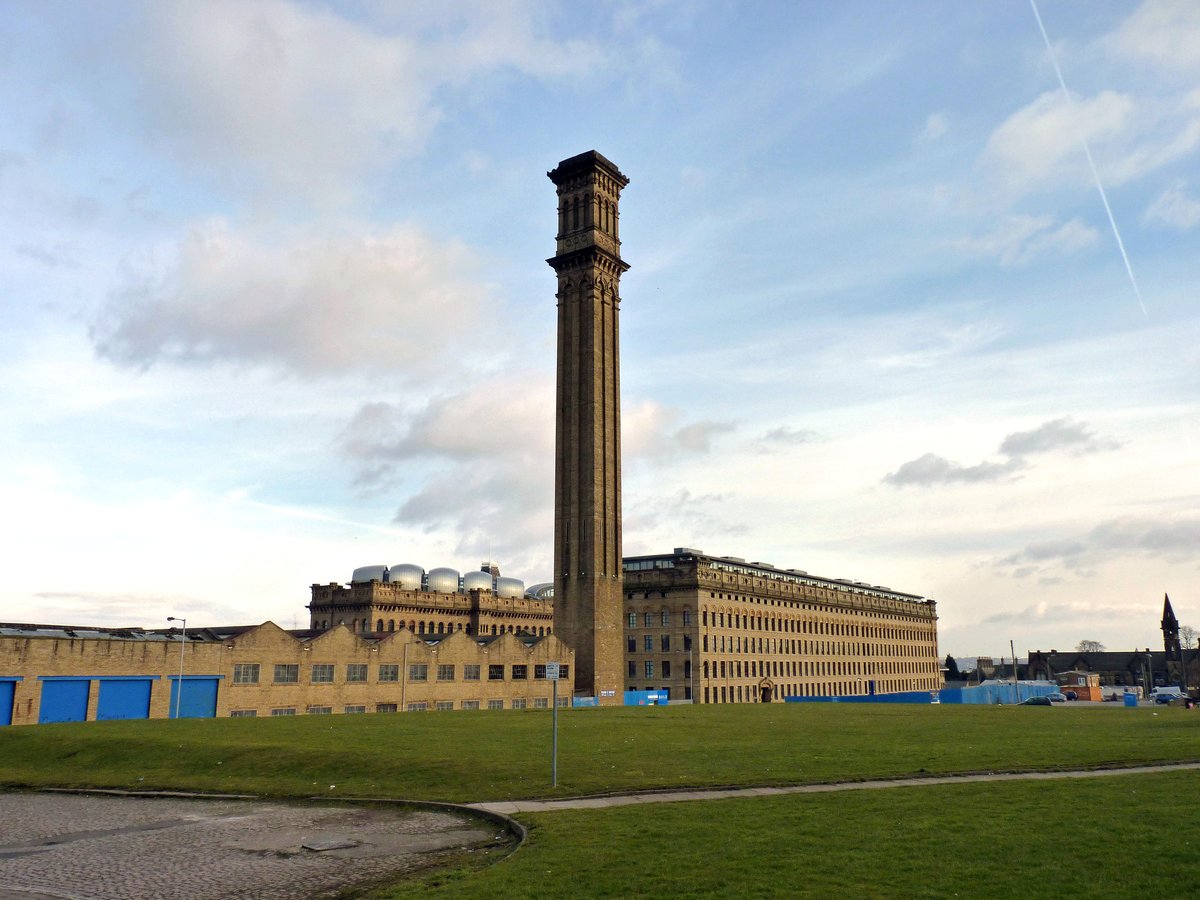
Lister Mills in Bradford, West Yorkshire, England, stands tall in the Manningham district since 1873. Samuel Cunliffe Lister built it to replace the original Manningham Mills that had been destroyed by fire. Lister Mills is a Grade II* listed building, built in the Italianate style of Victorian architecture. On completion in 1873, Lister's was the largest textile mill in the north of England. The mill spans 27 acres (11 hectares) and boasts an imposing shape.
The chimney of the mill is 249 feet (76 meters) high, and can be seen from most areas of Bradford. It cost about £10,000 to build, and its total weight has been estimated at 8,100 tons. Until the arrival of electric power in 1934, the mill was driven by steam engines. At its height, Lister's employed 11,000 men, women, and children – manufacturing high-quality textiles such as velvet and silk. It supplied 1,000 yards (910 meters) of velvet for King George V's coronation and in 1976 new velvet curtains for the President Ford White House.
During the Second World War Lister's produced 1,330 miles (2,140 kilometers) of real parachute silk, 284 miles (457 kilometers) of flame-proof wool, 50 miles (80 kilometers) of khaki battledress and 4,430 miles (7,130 kilometers) of parachute cord. A strike in 1890–91 at the mill was important in the establishment of the Independent Labour Party which later helped found the modern-day Labour Party. The Listers' business decreased considerably during the 1980s.
Stiff foreign competition and changing textile trends such as increased use of artificial fibres were the reasons. In 1999, the mills were closed. Being a prominent structure, the mills attracted a great deal of attention and several regeneration proposals came and went. The sheer size of the buildings being a major difficulty. In 2000, property regeneration company Urban Splash bought Lister Mills from the administrators, with plans to renovate the silk warehouse.
Construction was finished in 2006, but evidently left a majority of the site unmaintained. The second phase was the regeneration of the largest building on the site, the velvet mill, by replacing the existing roof of the building with a glass and steel structure, housing two storey apartments and creating additional ground floor commercial spaces, whilst preserving original architectural features under the design of David Morley Architects. The new homes went on sale in early 2007.
Sources: Wikipedia, OpenStreetMap, Wikidata, Wikimedia Commons
Written by Nicolo Ciampini
Discuss this with the author and others
No comments yet. Be the first to start the conversation.