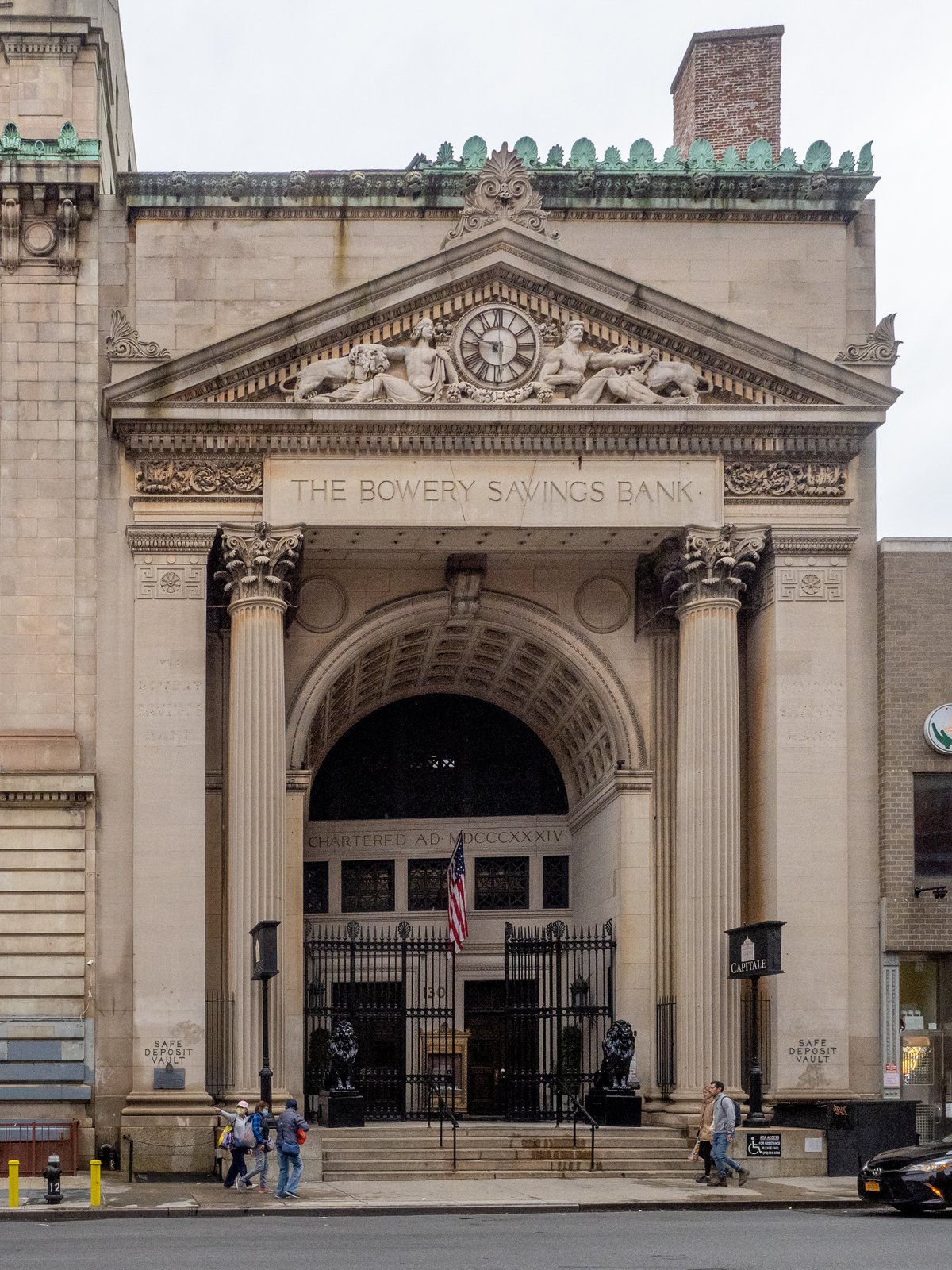
The bank at 130 Bowery looks less like a place to deposit spare change and more like a Roman temple. The headquarters building at 128-130 Bowery was designed by Stanford White and completed in 1895. He used yellow Siena marble for the teller counters and had Frederic MacMonnies carve out sculpted pediments for the exterior. White's choice of a Roman classical style set a trend for bank buildings in New York and across the United States.
At its peak between 1930 and 1976, Bowery Savings was the largest savings bank in the country. They managed a massive operation with over 35 branches by 1980. From 1972 to 1992, the bank's spokesman was Joe DiMaggio.
Then reality hit. Bank deregulation sent interest rates climbing and the bank began to suffer losses. By 1982, the institution was running out of cash. The FDIC arranged for the bank to be sold in 1985 for 100 million dollars. The deal allowed the bank to maintain a capital deficit of 220 million dollars rather than paying out on 5 billion dollars in deposits.
Today, the heavy marble is still there. The interior was designated a landmark in 1994, preserving the mosaic floors and faux marble scagliola columns. The building is now an upscale venue.
Sources: Wikipedia, OpenStreetMap, Wikimedia Commons




Written by Kyle McLonely
Discuss this with the author and others
No comments yet. Be the first to start the conversation.