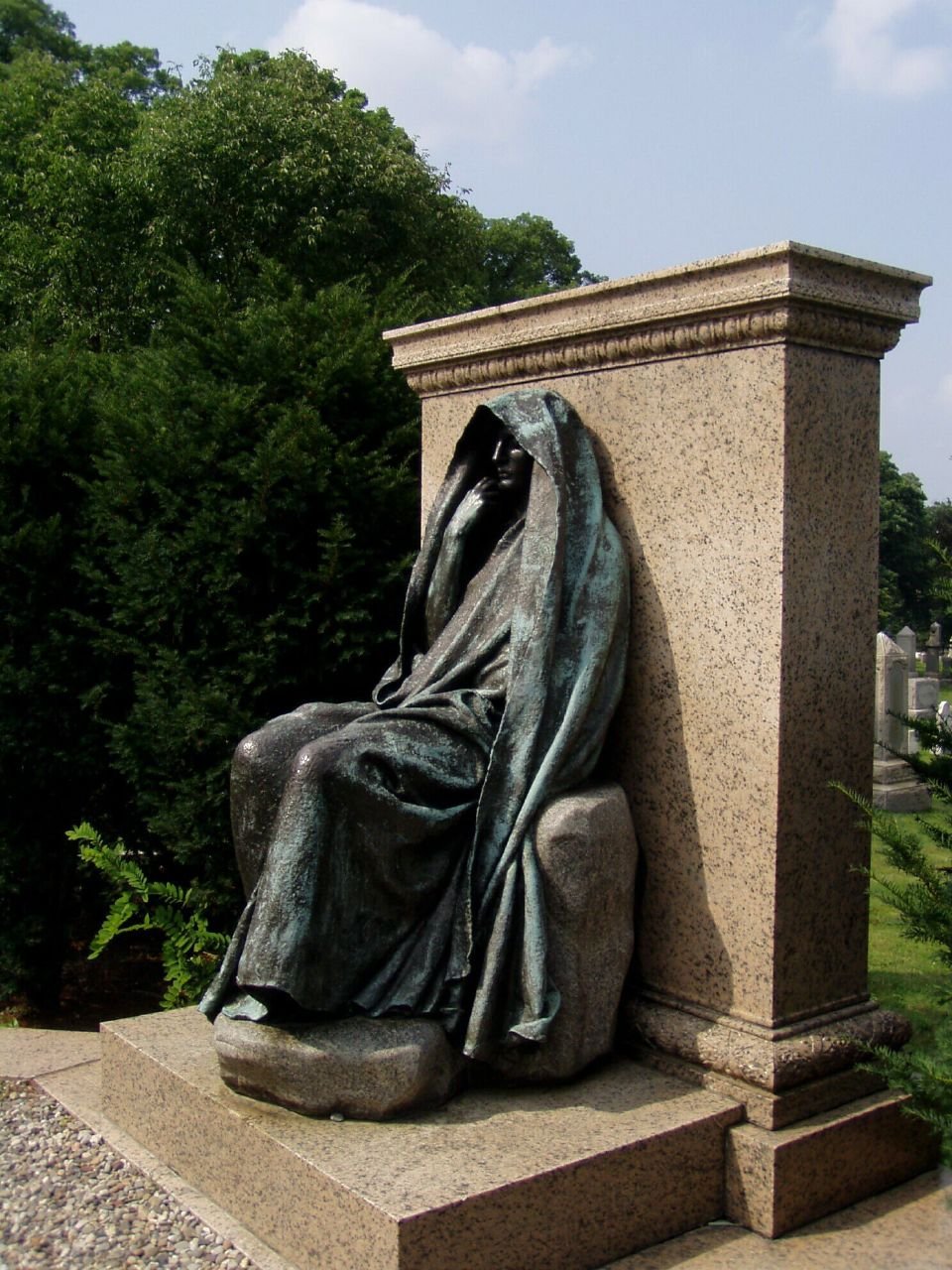

I spent several years trying to create my own monument. I had the means, the connections, and the persistent vision of a headstone that would capture the essence of my wife Marian. But when she took her own life in 1886, I was left with an ambiguous grief that eluded words and traditional markers. I wanted something unique, something that would leave room for mystery and reflection. So, I turned to America's most promising sculptor, Augustus Saint-Gaudens.
I described my vision to him, inspired by my travels to Japan and my fascination with Buddhist art. I showed him a painting of Kannon by Kanō Motonobu, which had been a source of great inspiration to me. Eventually, he came up with a final design, which was inspired by that painting and featured a veiled lady sitting on a granite platform. The statue, known as Grief, was completed in 1891 and installed in Section E of Rock Creek Cemetery in Washington, D.C.
Despite my wish that the statue would be a reflection of Eastern wisdom, it quickly gained popularity, and after St. Gaudens' death in 1908, it became a symbol of artistic genius lost too soon. Today, it is listed on the National Register of Historic Places, and can still be found in Rock Creek Cemetery, where it continues to evoke contemplation and reflection.
Sources: Wikipedia, OpenStreetMap, Wikidata, Wikimedia Commons
Written by Friendly Jane
Discuss this with the author and others
No comments yet. Be the first to start the conversation.