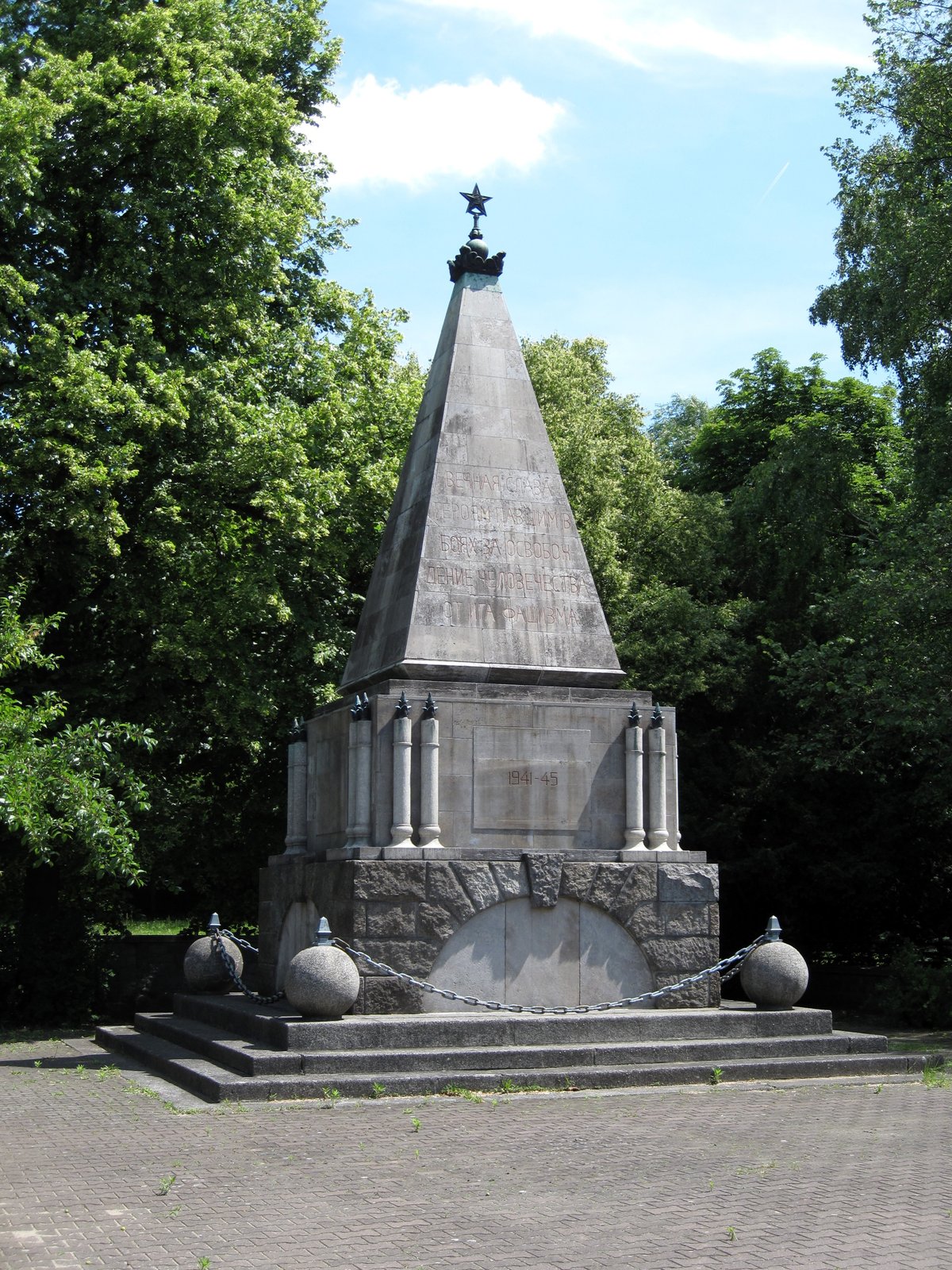
A pyramid-obelisk rises from the old village core of Buch, its lines tracing the curve of early Neoclassical design. It is a quiet weight in the landscape, situated next to the Wiltbergstraße where the ghosts of 1945 remain anchored to the soil. While it stands today as a place of remembrance, it was not always intended to be a hollow monument.
Between 1947 and 1948, the Soviet Military Administration in Germany ordered the construction of this site. Architect Johann Tenne was tasked with a specific aesthetic goal: the base, the pedestal, and the obelisk had to harmonize with the neighboring Bucher Schlosspark. He chose a style that leaned toward the classical, allowing the memorial to sit in the landscape without shattering the visual continuity of the surrounding castle park and its restored church.
In its earliest days, the memorial held a more intimate, physical purpose. It was designed to serve as a gravesite for the Red Army soldiers who fell during the Battle of Berlin in April 1945. For a time, these bodies remained in the earth here, making the site a literal resting place for those who died in the final weeks of the war.
That purpose changed as the politics of commemoration shifted. The bodies were eventually moved to the Soviet War Memorial in Schönholzer Heide, stripping the Buch site of its role as a cemetery but leaving its status as a shrine. It transformed into a site of memory alone - a place where the names of the fallen stay in the air rather than in the ground.
The state of Berlin recognized the importance of this transition in the 1990s. They spent 60,000 DM to renovate the ensemble, ensuring the Neoclassical stone would endure the weathering of the decades. Today, if you walk from the S-Bahn station just 150 meters away, the memorial appears as a steady, intentional presence in the park, a piece of history that was reshaped to survive its own original intent.
Sources: Wikipedia, OpenStreetMap, Wikidata, Wikimedia Commons



Written by Aurora
Discuss this with the author and others
No comments yet. Be the first to start the conversation.