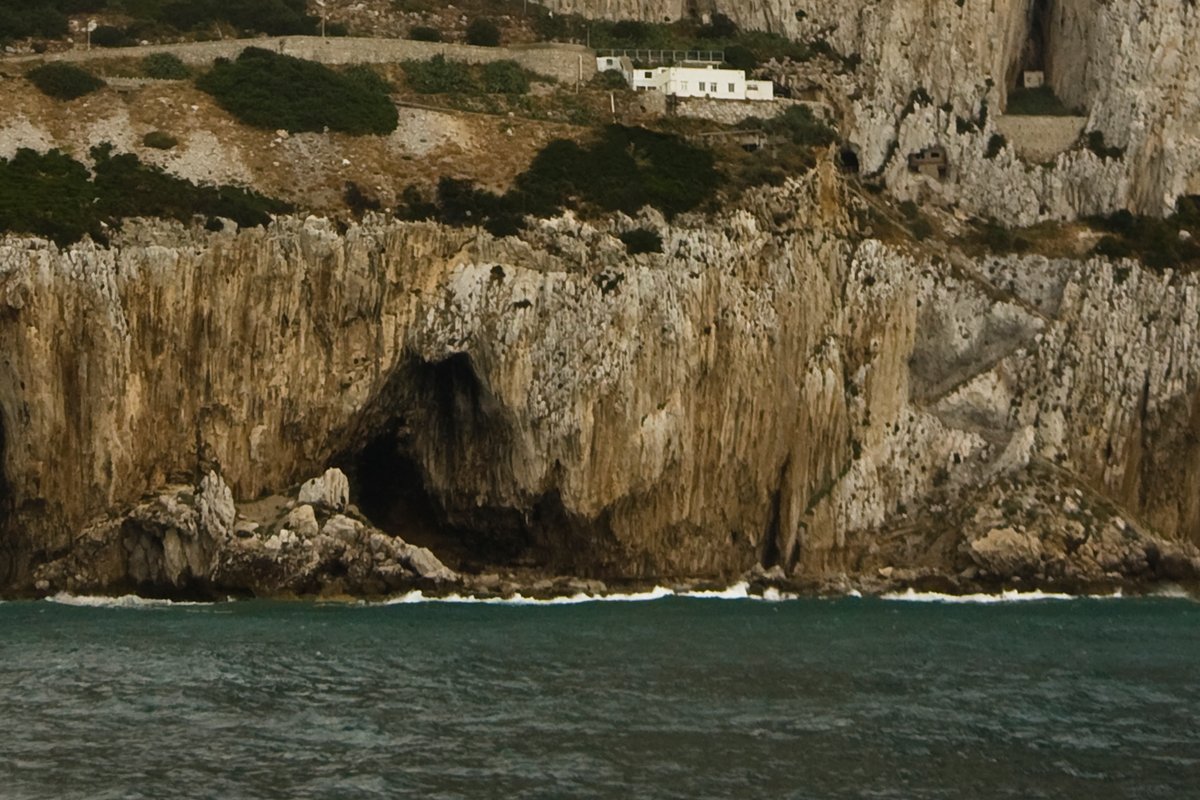

Gorham's Cave, located in the British overseas territory of Gibraltar, is one of the last known habitats of the Neanderthals in Europe. Discovered in 1907 by Captain A. Gorham, this UNESCO World Heritage Site is located on the southeastern face of the Rock of Gibraltar. Initially, the cave was approximately 5 km (3.1 mi) from the shore, but is now just a few metres from the Mediterranean Sea due to sea level changes.
Initially discovered by Captain A. Gorham, it seems the cave was forgotten - at least at an official level - as Gibraltarian historian and potholer George Palao recalls an inscription on the cave wall that read J. J. Davies 1943.
Royal Engineers Keighley and Ward found pottery, stone tools, human and animal remains in Gorham's Cave in the late 19th century. George Baker Alexander, a Royal Engineer and geologist, was the first to excavate Gorham’s Cave in 1945. John d'Arcy Waechter, a fellow of the British Institute of Archaeology, began excavations in Gorham's Cave in 1948 and returned several times until 1954.
In 2021, archaeologists discovered a 40,000 year-old Neanderthal cave chamber in the Gorham's Cave Complex. This site has four layers of stratigraphy. Level I has produced evidence for eighth to third centuries BC use by Phoenicians. Level II produced evidence for brief Neolithic use.
Level III has yielded at least 240 Upper Paleolithic artefacts of Magdalenian and Solutrean origin. Level IV has produced 103 items, including spear-points, knives, and scraping devices that are identified as Mousterian. AMS dating gives dates for level IV of between 33 and 23 thousand years before the present (kyr BP). The researchers felt that the uncertainties at this time depth made calibration impractical. They suggest occupation until at least 28 kyr BP and possibly 24 kyr BP.
No fossil remains have been found that would allow identification pointing to either Neanderthal or anatomically modern human inhabitants. The scratches in Gorham's Cave are at least 39,000 years old. The scratches in Gorham's Cave are found below a layer of undisturbed sediment. The scratches in Gorham's Cave are arranged in two groups of three long lines and intersected by two shorter ones. The scratches in Gorham's Cave are located approximately 100 metres from the cave entrance. The scratches in Gorham's Cave cover an area of around 1 m2. The scratches in Gorham's Cave were found on a ledge.
Sources: Wikipedia, OpenStreetMap, Wikidata, Wikimedia Commons
Written by Nik Frost
Discuss this with the author and others
No comments yet. Be the first to start the conversation.