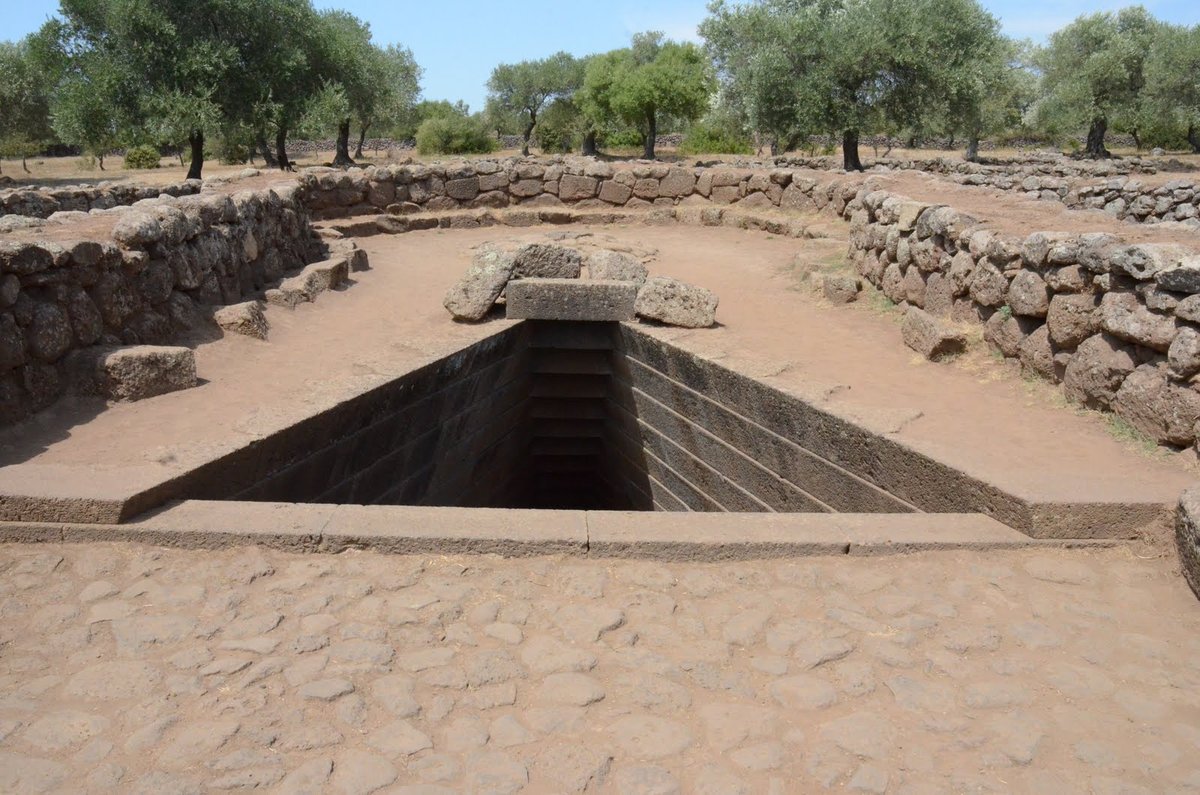
At first glance, the Well of Santa Cristina appears almost impossibly precise. Built between the 12th and 11th centuries BC by the Nuragic civilisation, the underground sanctuary is widely regarded as one of the finest examples of prehistoric architecture in Europe.
A perfectly proportioned basalt staircase descends into a circular chamber where an underground spring still flows. Every stone was cut with remarkable accuracy, creating a structure that continues to astonish engineers and archaeologists alike. During certain astronomical events, particularly around the equinoxes and major lunar standstills, sunlight or moonlight aligns dramatically with the opening above the chamber—a feature that has fuelled decades of research into its possible ceremonial and astronomical significance.
Surrounded by the remains of a sacred village, the well invites visitors to contemplate both the technical skill and the spiritual sophistication of the people who built it more than three thousand years ago. Few places illustrate the ingenuity of Sardinia's ancient inhabitants quite so powerfully.
Written by Sardinian
Discuss this with the author and others
No comments yet. Be the first to start the conversation.