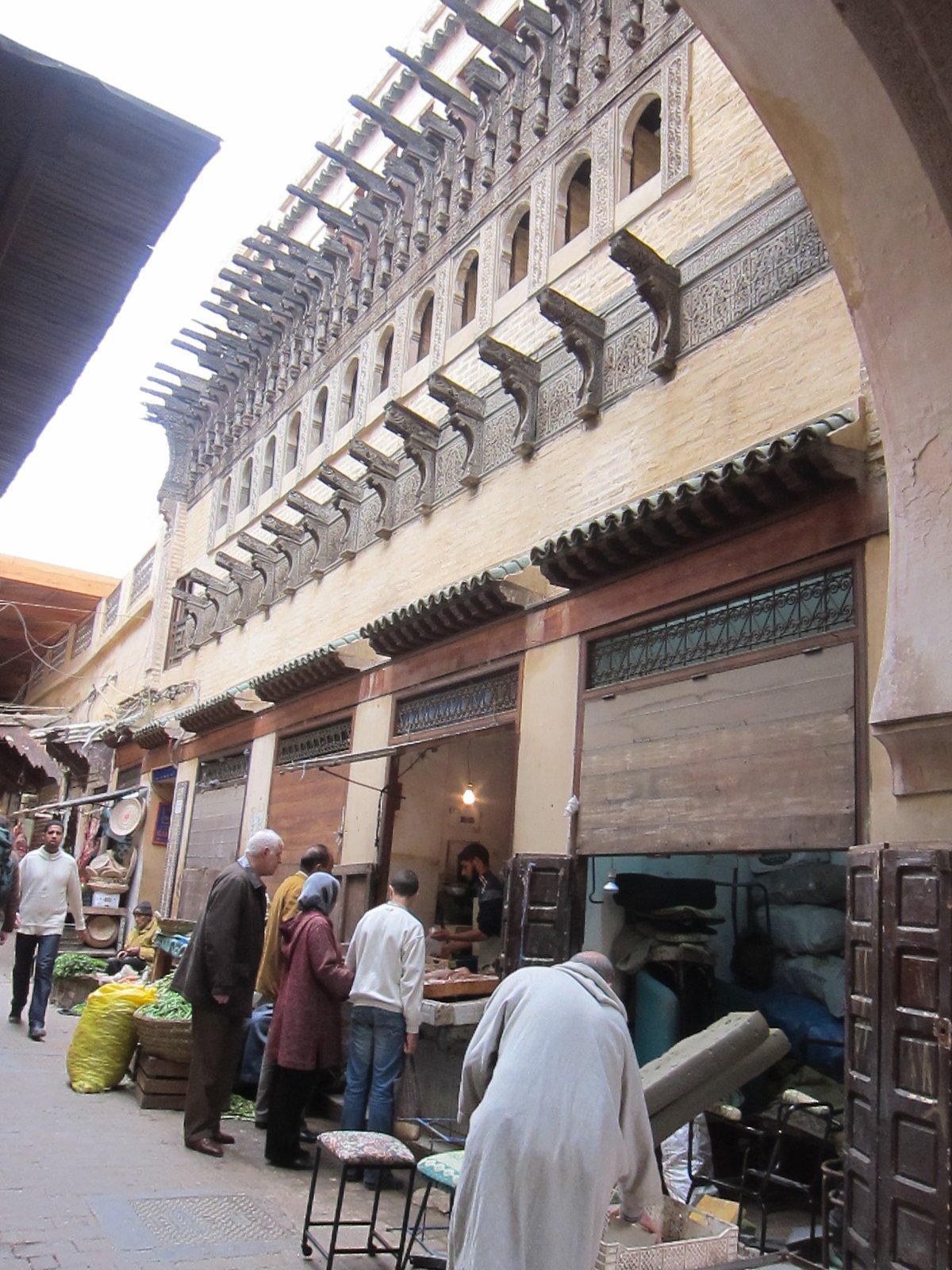

The Marinid Sultan Abu Inan Faris raised Dar al-Magana in the mid-1300s to govern the hours for the nearby Bou Inania Madrasa. Located opposite the madrasa on Tala'a Kebira street, the building served as a functional centerpiece of a large charitable complex. The water clock, completed in 1357 by the muwaqqit Abu al-Hassan ibn Ali Ahmed el-Tlemsani, was designed to serve the madrasa and its mosque.
Inside these walls, a small cart moved from left to right behind twelve doors, pulled by ropes. At one end, the cart was attached to a rope with a hanging weight; at the other, to a rope with a weight that floated on the surface of a water reservoir that was drained at a regular pace. Every hour, one of the doors opened as a metal ball was dropped into one of the twelve brass bowls to announce the passing of the hour.
Today, the structure remains a testament to ancient craft. The brass bowls were removed in 2004 in an attempt to repair or reconstruct the mechanism, though the project managed by ADER-Fes has been unsuccessful so far. A visitor can still see the facade decorated with carved stucco and the wooden rafters that once shielded the doors and bowls. The heart of the house no longer beats, leaving a ghost of science for any wandering soul to witness near the Bou Inania Madrasa.
Sources: Wikipedia, OpenStreetMap, Wikidata, Wikimedia Commons
Written by Mutabor
Discuss this with the author and others
No comments yet. Be the first to start the conversation.