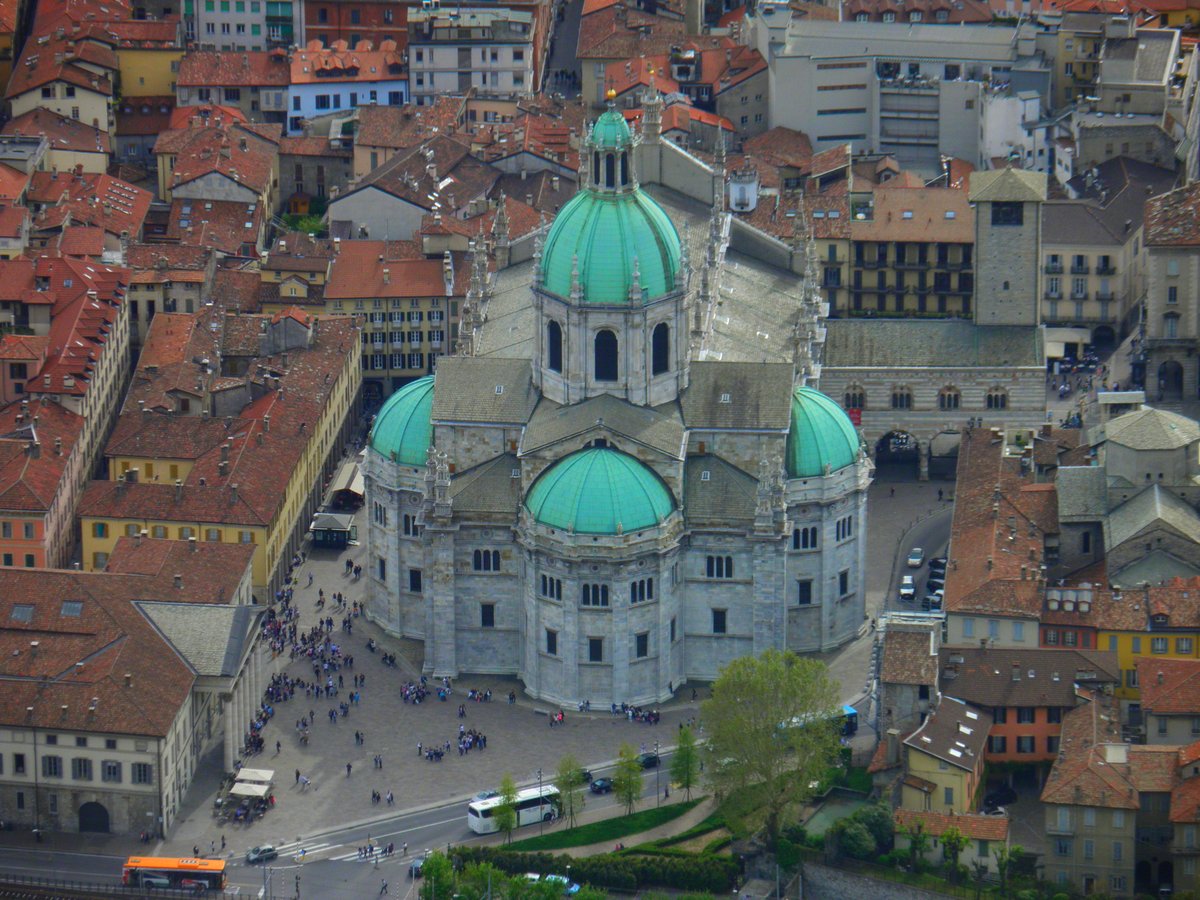

The Cathedral of Como, dedicated to the Assumption of the Blessed Virgin Mary, stands as the Catholic cathedral of the city of Como, Lombardy, Italy. Known as the Duomo di Como, it is the seat of the Bishop of Como. The cathedral is a significant example of the last Gothic period in Italian architecture, making it a unique monument in Italy. The construction of the cathedral began in 1396, 10 years after the foundation of Milan Cathedral, and was completed in 1770 with the addition of the Rococo cupola by Filippo Juvarra.
The imposing west front, featuring a rose window and a portal between two statues of Pliny the Elder and Pliny the Younger, was built between 1457 and 1498. The cathedral is 87 meters long, 36-56 meters wide, and 75 meters high into the top of the cupola. It has a Latin cross floor plan with a central nave, two side aisles, and a Renaissance transept. The apses and the choir are of the 16th century. The interior features a series of nine important tapestries, woven at the end of the 16th century, in Ferrara, Florence, and Brussels.
The cathedral also houses a number of 16th-century paintings, including those by Bernardino Luini and Gaudenzio Ferrari. Today, the Duomo di Como is a vibrant part of the city's cultural life, often hosting concerts and events.
Sources: Wikipedia, OpenStreetMap, Wikidata, Wikimedia Commons
Written by Nicolo Ciampini
Discuss this with the author and others
No comments yet. Be the first to start the conversation.