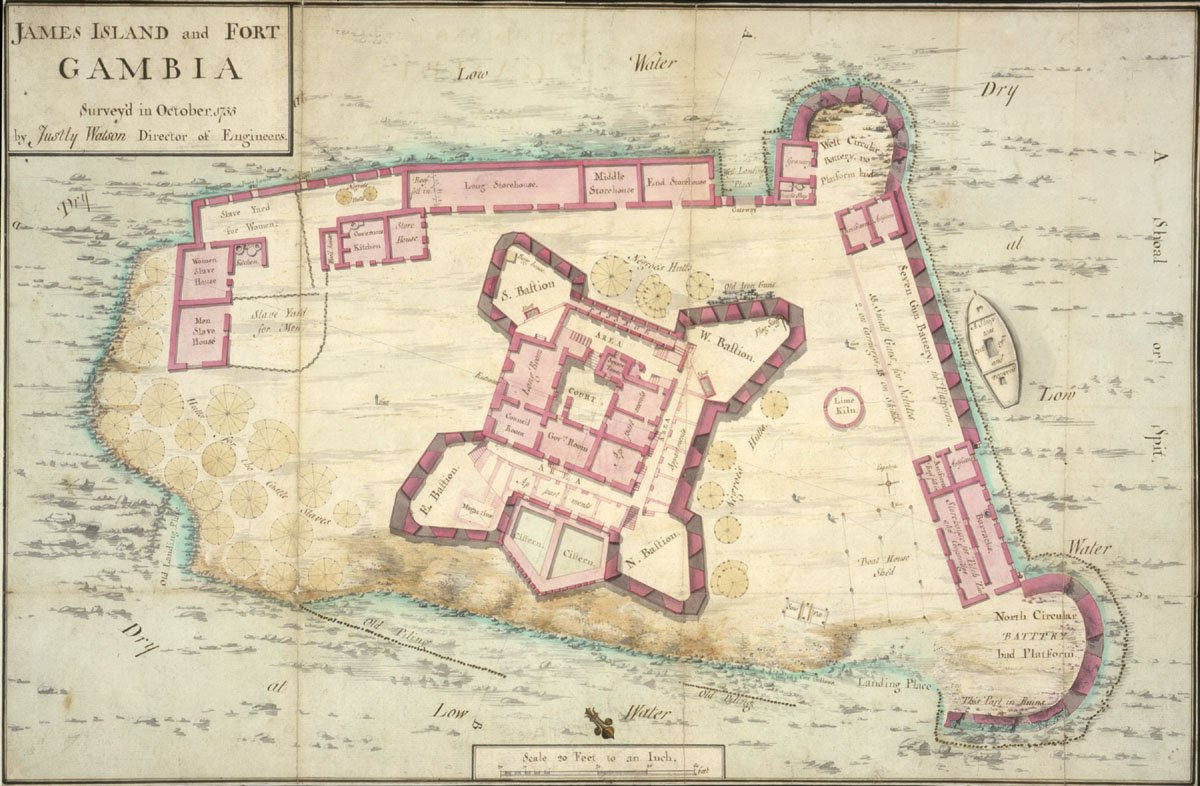

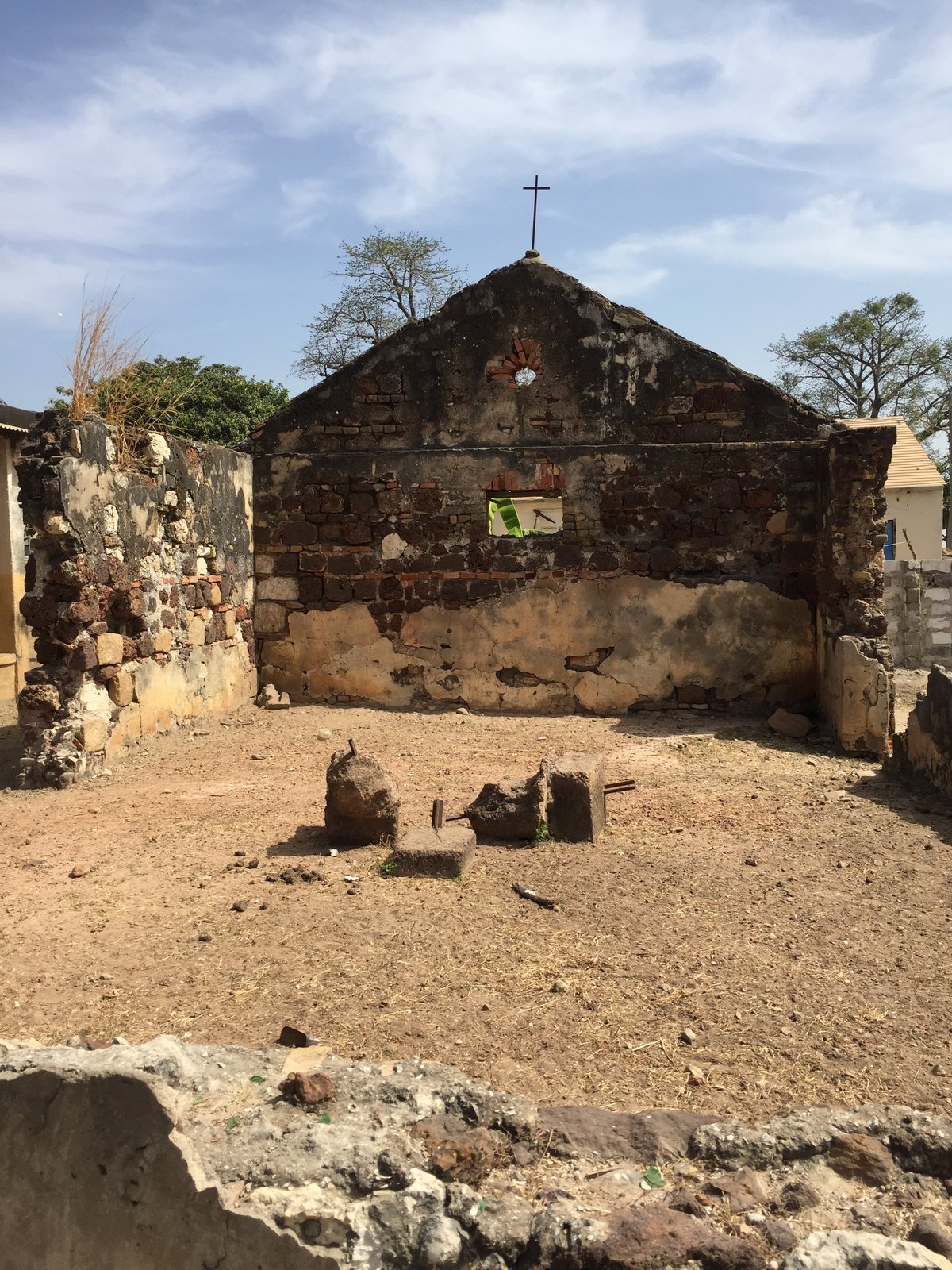
Kunta Kinteh Island, formerly called James Island and St Andrew's Island, is an island in the Gambia River, 30 km from the river mouth and near Juffureh. As an important historical site in the West African slave trade, it is listed as a UNESCO World Heritage Site together with related sites including a ruined Portuguese chapel and a colonial warehouse in Albreda, the Maurel Frères Building in Juffureh, and Fort Bullen and Six-Gun Battery at the mouth of the Gambia River.
The first record of European interaction with the island is in May 1456, when a Portuguese expedition led by Italian explorers Alvise Cadamosto and Antoniotto Usodimare moored off the coast. They buried one of their sailors, named André, on the island, giving it its first European name - St Andrew's Island. A Portuguese settlement, Santo Domingo, was built on the northern bank of the Gambia River opposite the island in the 15th century.
In 1651, settlers from the Duchy of Courland and Semigallia built a fort they named Jacob Fort after Jacob Kettler, Duke of Courland. The main building was a rectangle flanked at each corner by a triangular bastion. The island served as a trade base until the Dutch West India Company took it over in 1659, before the English captured it in 1661. The English renamed the island James Island and the fort Fort James after James, the Duke of York.
The island was later used for the ivory and slave trades. Between 1758 and 1779, the Gambia was part of British Senegambia. In 2011, at the request of artist Chaz Guest to President Yahya Jammeh, the island was renamed Kunta Kinteh Island to give it a Gambian name. A miniature replica of a statue of Kunta Kinte was revealed during the renaming ceremony.
Sources: Wikipedia, OpenStreetMap, Wikidata, Wikimedia Commons
Written by Mutabor
Discuss this with the author and others
No comments yet. Be the first to start the conversation.