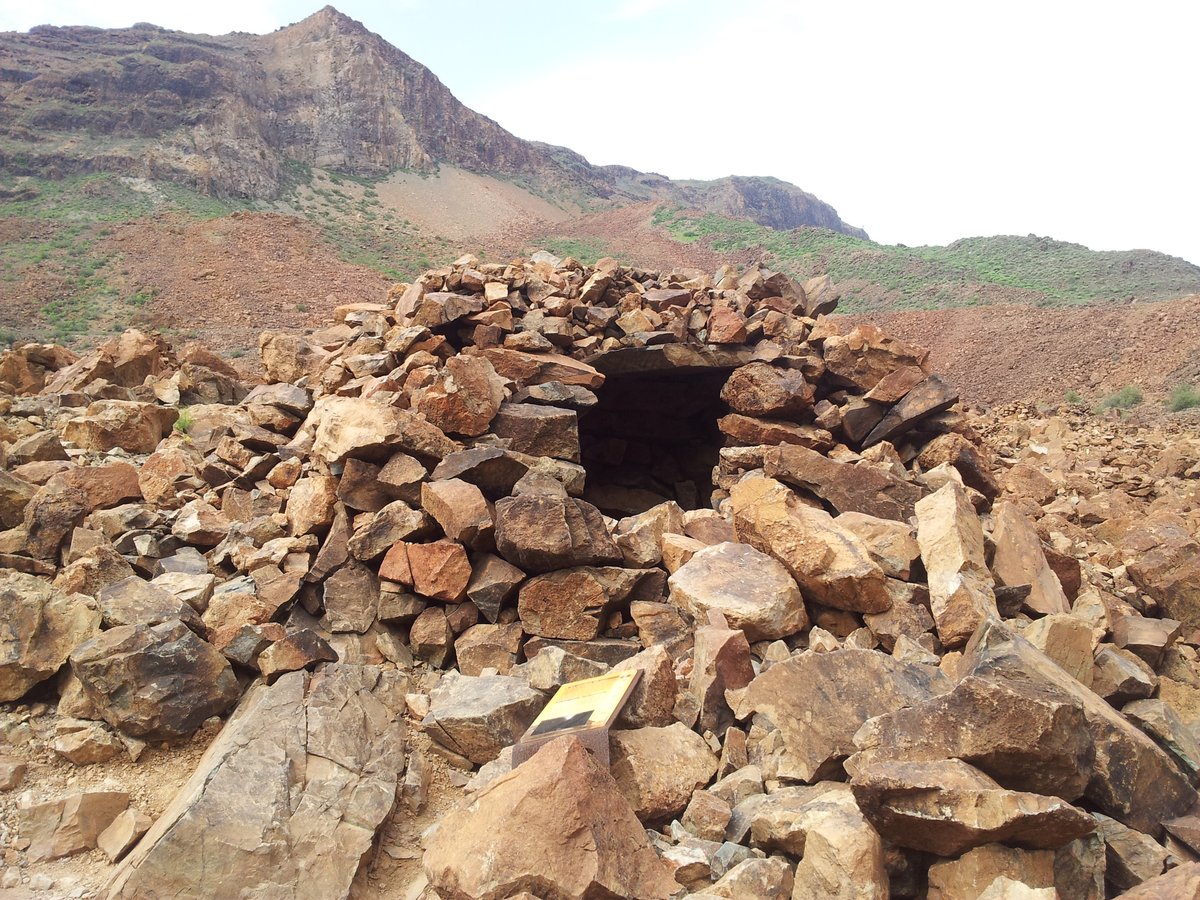

Located in the south of Gran Canaria on the right bank of the Barranco de Fataga, the Necrópolis of Arteara is the largest cemetery of the island's indigenous people. Situated near the locality of Arteara in the municipality of San Bartolomé de Tirajana, the site covers an area of 137,535 m² and was originally surrounded by a dry stone wall. The burials consist of more than 800 tumuli built using stones from a nearby mountain collapse known as Morro Garito.
The site is composed of an extensive indigenous cemetery enclosed by a dry stone wall nearly one meter high. The burials were constructed as dry stone tumuli, featuring a cist-like mortuary box where the body was placed, covered by a superstructure or tower. These structures are arranged throughout the malpaís landscape in various configurations, including troncoconic, pyramidal, circular, and rectangular shapes.
Chronological dating of the site indicates use from the 5th century BC until well into the 18th century. This means the population of the Barranco de Fataga continued using the cemetery for centuries after the Castilian conquest, totaling 2,300 years of use. The site also features archaeo-astronomical phenomena during the equinoxes. During the spring equinox, a ray of sunlight passes through a depression in the Amurga massif to strike the tumulus known as El Rey, while during the autumn equinox, a double solar transit occurs as the sun is momentarily hidden by the rocks.
In 1973, the site was declared a national historic-artistic monument by decree of the Ministry of Education and Science. It was later classified as a Bien de Interés Cultural with the category of archaeological zone in 1985. In 2014, an interpretation center was opened, making it one of the archaeological parks in Gran Canaria.
Sources: Wikipedia, OpenStreetMap, Wikidata, Wikimedia Commons
Written by Mutabor
Discuss this with the author and others
No comments yet. Be the first to start the conversation.