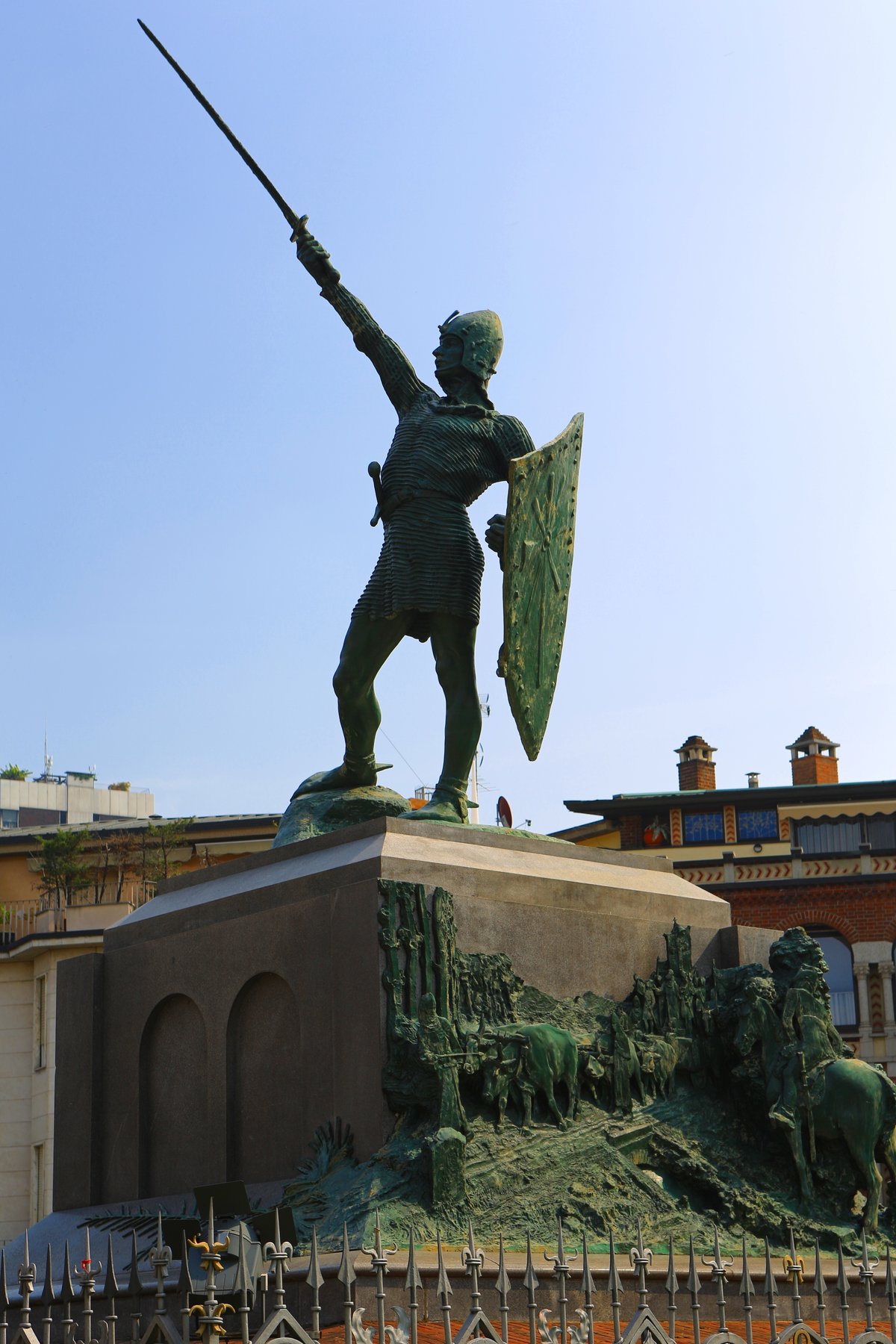

Why did a 19th-century monument literally melt? Because of a delay in plans following a request to build the work in another city.
When Legnano tried to commission a statue to celebrate the defeat of Frederick Barbarossa, the people of Milan requested to build the monument in their city. When that request was later denied, the sculpture project faced delays. Because of these delays, only the base was built in time for the scheduled inauguration on May 24, 1876. To ensure the celebration could proceed, the first statue was made of papier-mâché and plaster - materials that did not allow the sculpture to withstand the weather.
The current bronze warrior, inaugurated in 1900, finally solved the problem of weather resistance. Sculptor Enrico Butti designed the figure to be a vertical explosion of movement, with one leg rooted firmly to the ground and a sword thrust upward. It captures the exact moment of rejoicing after the imperial army was beaten.
If you look at the gray granite base, you can see the Porta Romana on the front and a list of the Lombard League cities on the side. It is a bit of a historical paradox. While the 19th-century residents saw it as a story of patriotic unity, later historians pointed out the locals were actually just fighting for more autonomy from the Holy Roman Empire. Still, the image was so effective it was later used as a logo by various military groups, including the 58th Infantry Division "Legnano" and the Mechanized Brigade "Legnano", as well as the Lombard Regional Autonomist Movement.
Sources: Wikipedia, OpenStreetMap, Wikidata, Wikimedia Commons
Written by Nicolo Ciampini
Discuss this with the author and others
No comments yet. Be the first to start the conversation.