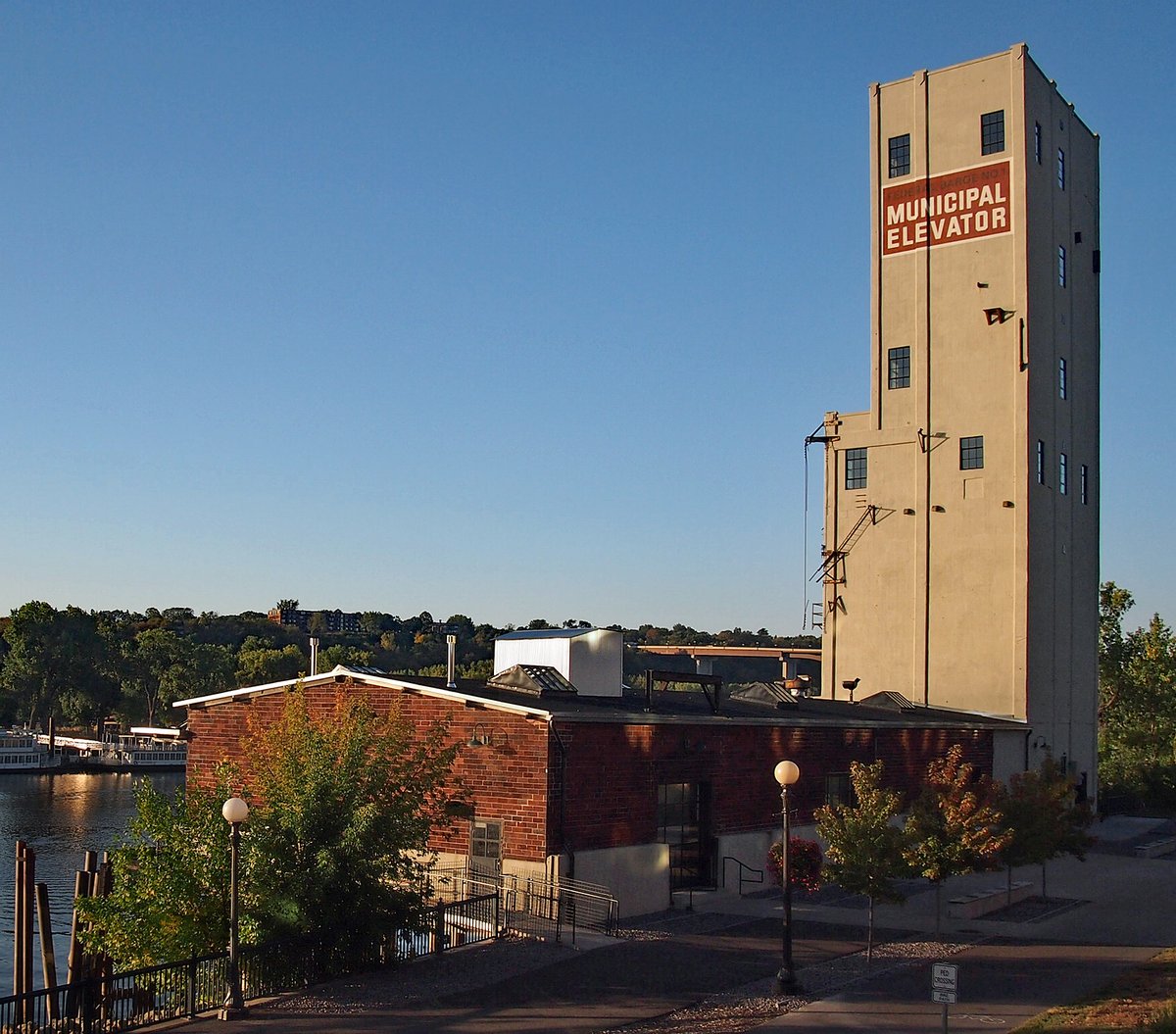
This six-story building sits on piers over the Mississippi River. Built between 1927 and 1931, it was the first successful grain terminal elevator owned and operated by a farm cooperative in the United States. It was recognized for its national significance in the farmers' cooperative movement during the 1920s and 30s.
At its peak, the facility included 90 grain silos, a small mill, a head house for loading grain onto barges and train cars, and a sack house for sacking milled flour. The structure served as a remnant of Saint Paul's early history as a Mississippi River port city.
By the turn of the millennium, the structure was in a dilapidated state. It was listed as one of the most endangered historic sites in Minnesota. Redevelopment plans for the Upper Landing stalled because the grain terminal was too far gone to ignore, but was acknowledged by a task force as historically significant and worth saving.
The city eventually threw a global competition called WHAZIT! to figure out a new purpose. Over 200 ideas from 13 countries flooded in. They picked a plan to turn it into City House. Today, it functions as a park pavilion, interpretive center, and event venue, managed by Saint Paul Parks and Recreation.
You can walk through it from dawn to dusk. It stands as a cantilevered structure over the Mississippi River, now repurposed for meetings and gatherings instead of as a grain terminal.
Sources: Wikipedia, OpenStreetMap, Wikidata, Wikimedia Commons

Written by Kyle McLonely
Discuss this with the author and others
No comments yet. Be the first to start the conversation.