
The Battle of Piteå occurred on 25 August 1809, near Piteå, Sweden. A Swedish naval force under the command of Major C.F. von Hauswolff was ordered to cut off the northward retreat of a Russian force under General Nikolay Kamensky which had been defeated by the Swedes five days earlier at Ratan. The Swedish attempt to hem in the Russians was rebuffed, as the Russian victory became the last battle which took place on Swedish soil during the war and remains the most recent battle to have taken place in Sweden. The Swedish naval force, also tasked with capturing any Russian vessels which they found sailing northwards, arrived south of Piteå at the island of Pitholmen on 25 August.
Upon seeing the Swedes, a Russian soldier was ordered to ride quickly on his horse to spread news of their sudden arrival, but was killed by fire from one of the Swedish sloops. The bridge that the Swedes were meant to destroy was clearly visible from the water and it was determined that it could be destroyed easily by a cannonade from the sloops. Major Hauswolff, however, thought it more appropriate to destroy the bridge personally, and resolved to row on a launch in the direction of the bridge.
Predictably, he quickly came under fire from the Russian pickets on the beach and was badly injured. Command fell to Georg Samuel von Gegerfelt, who decided to take the Swedish ships into the narrow strait towards the bridge, but was quickly beset on both sides by Russian infantrymen. A desperate Swedish attempt to reach the bridge was initiated by a Lieutenant Everlöf in particular who advanced under the guard of some sloops, but he and the men accompanying him were shot down by the Russians who had the high ground, and a retreat was deemed necessary.
The Swedes quickly determined that a landing would likely not be possible given the strong positioning of the Russian forces, but were still determined to try. However, the squadron then spotted a force of thirteen Russian transport vessels incoming from the South, intent on resupplying the Russian land forces, so two Swedish sloops were sent out to initiate an attack on the enemy ships. These two vessels were forced to retreat back to the Jarramas, however, upon seeing that the transport ships were being escorted by two heavily armed cannon boats. The Swedish squadron quickly retired southwards upon realizing the hopelessness of their situation.
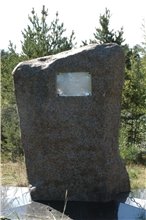
After the battle, the Russian forces retreated northwards, marking the end of the war on Swedish soil. The battle site went on to become a memorial, erected in 1999 and dedicated to peace and remembrance. Every August 25th, Swedish King Carl XVI Gustaf and the Russian ambassador to Sweden lay wreaths at the site, commemorating the fallen soldiers from both sides.
Sources: Wikipedia, OpenStreetMap, Wikidata, Wikimedia Commons
Written by Nik Frost
Discuss this with the author and others
No comments yet. Be the first to start the conversation.