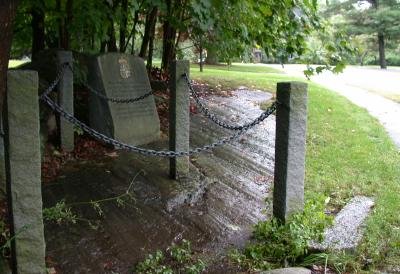
A glacial boulder in Westford, Massachusetts, contains a pattern that people cannot agree on. In the 19th century, it was described as a rude figure supposedly cut by an Indian artist. Later, it was interpreted as a broken Viking sword, until 1954 when Frank Glynn chalked a full figure of a medieval knight onto the rock, complete with a sword and shield.
Some people claim the shield shows the heraldry of the Sinclairs of Scotland. They believe it commemorates a fallen member of Henry I Sinclair's party, who some believe traveled to the New World in 1398. As of 2025, a stone monument next to the rock commemorates this interpretation as fact, though there is no evidence for the claim.
Archaeologist Kenneth Feder noted that the stone appears to get fresher every year, which he says is impossible. He argues that while the 19th-century petroglyph and glacial striations likely existed, the knight in his regalia resides only in Glynn's imagination. He suggests a metal rod may have been used to punch a partial sword shape into the rock, while other images might have been added later.
You can visit the site to see the stone and a monument that treats the Sinclair voyage as fact. There is no evidence for the trip, but there is plenty of evidence for human imagination.
Sources: Wikipedia, OpenStreetMap, Wikidata, Wikimedia Commons


Written by Leroy
Discuss this with the author and others
No comments yet. Be the first to start the conversation.