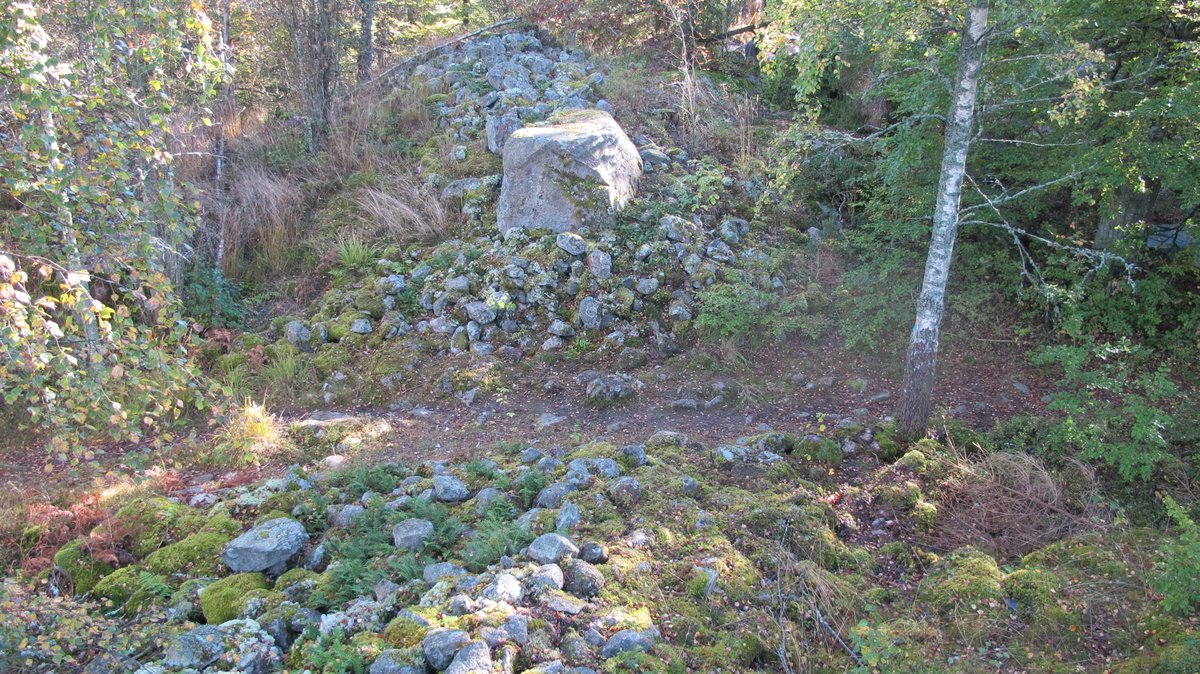

Archaeological investigations suggest that Gripeberg, a 200 x 90-meter 'fornborg' or ancient stronghold, is a wall enclosure used in a context of cultic, religious, or ritual events. The site is located in Notteryd in Gårdsby socken in Växjö kommun in Småland.
The enclosure is situated on the height of a long-stretched urbergsdrumlin with steep slopes along the western, north-eastern, and eastern sides. Below the height are lakes and marshy areas. The site is defined by clear walls in the north and south and a more sporadic wall in the west. In addition to the visible walls, there is a large-scale construction of continuous, small, low stone packings located under the ground.
The facility appears to have been constructed mainly during the Bronze Age, within the period 1630 – 410 BC. Previous research, based on prevailing traditions and knowledge, consistently judged all fornborgs as late Iron Age fortifications interpreted as refuges or defense facilities. Parts of the enclosure may also have been reused in historical times. The area around Växjö and central Värend has been continuously inhabited since the end of the Stone Age. Within a 2 km radius of the fornborg, there are no known remains. Gripeberg may have represented a common point between different settlement units during the Bronze Age.
Sources: Wikipedia, OpenStreetMap, Wikidata, Wikimedia Commons
Written by Nik Frost
Discuss this with the author and others
No comments yet. Be the first to start the conversation.