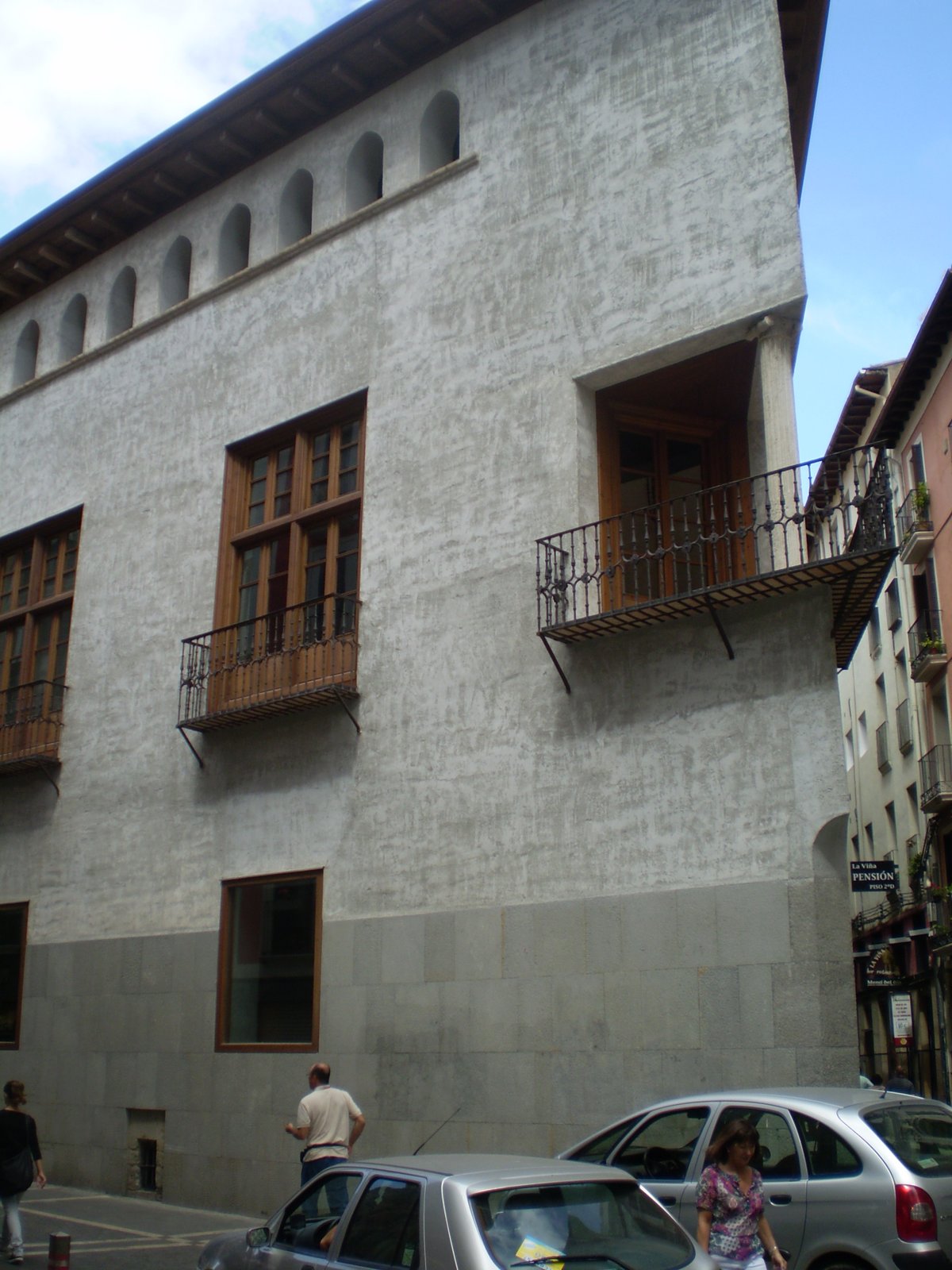

Situated in the heart of Pamplona at the intersection of Calle Mayor and Calle Jarauta, the Palacio del Condestable de Navarra is the only remaining example of 16th-century civil architecture in the city. It was established in 1548 when Luis de Beaumont, Condestable of Navarra, purchased four adjacent houses to expand his own residence. The palace served as the headquarters of the city council while the current baroque building was being constructed from 1752 to 1760.
After Beaumont's death, the palace passed to the house of Alba. In 1590, it was acquired by Bishop Bernardo Rojas and remained the official residence of the Bishopric of Pamplona for 150 years. In 1997, the building was declared a Bien de Interés Cultural. In 2000, the Ayuntamiento purchased the building to prevent its demolition and commissioned a restoration to recover the original configuration of the building.
Today, the palace functions as a civic center and cultural space known as Civivox Condestable. It houses the Sarasate Museum, which preserves the legacy donated by the musician Pablo Sarasate, and contains the offices of the Registro General del Ayuntamiento de Pamplona on the ground floor. Located on the Camino de Santiago, the building sits across from the 13th-century church of San Saturnino.
Sources: Wikipedia, OpenStreetMap, Wikidata, Wikimedia Commons


Written by Nicolo Ciampini
Discuss this with the author and others
No comments yet. Be the first to start the conversation.