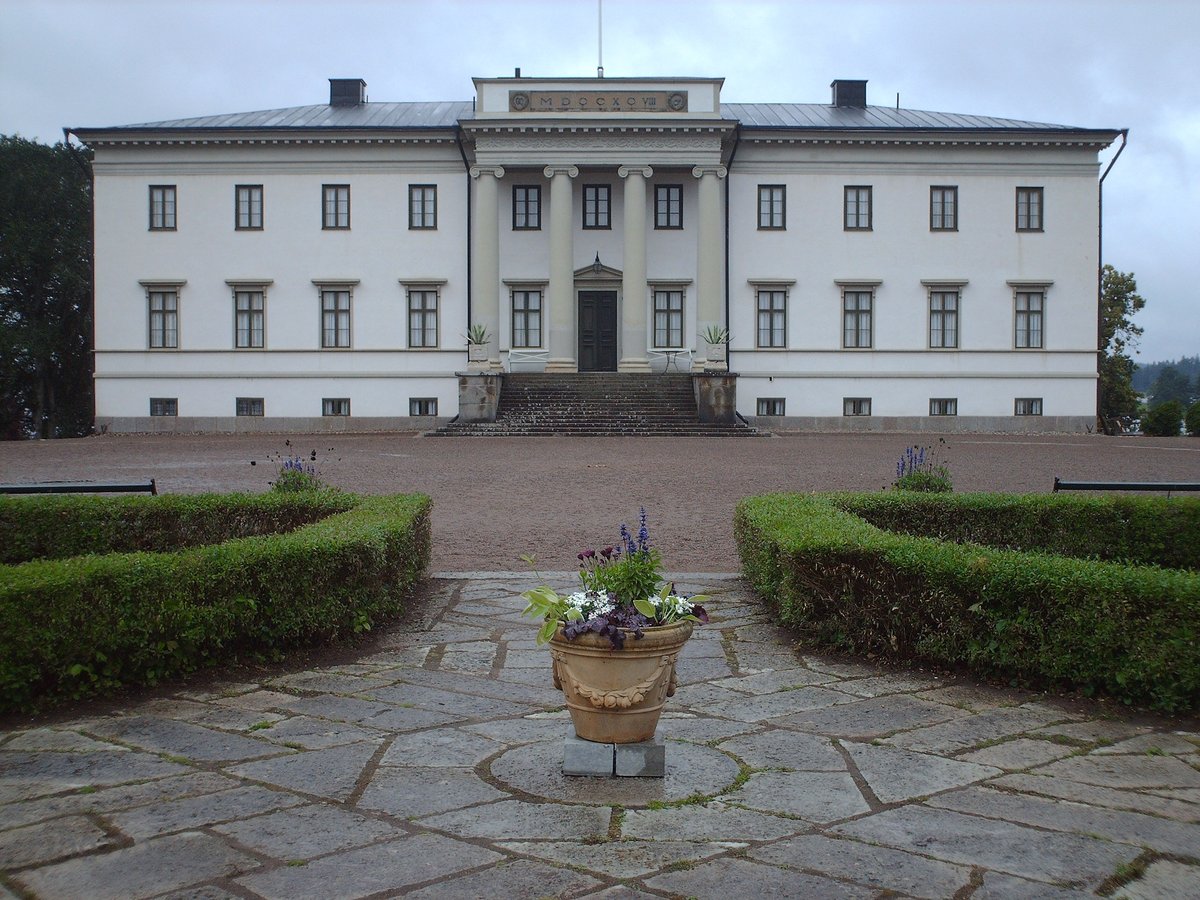

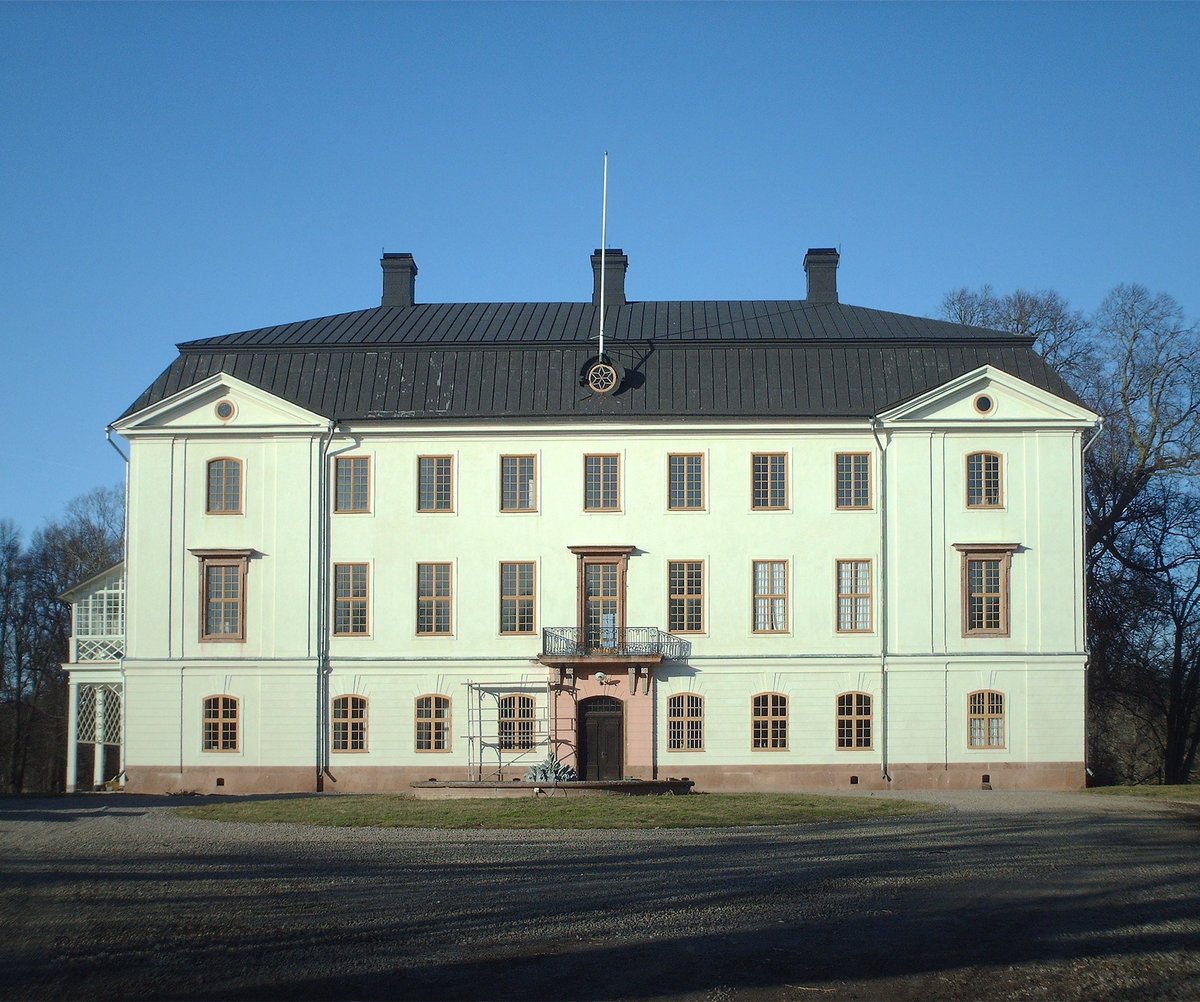
Stjernsunds slott is a museum in the municipality of Askersund, Närke, situated on a high headland between Stora Hammarsundet and Alsen, which form the northern part of Vättern. The current building was constructed between 1798 and 1801 according to designs by Carl Fredrik Sundvall in the then-modern neo-antique style. The main building features two floors and an economic floor with a protruding middle part in the form of a strong portico, supported by four thick columns resting on a high stone staircase.
The site originally held a stormaktstida castle complex of which only the cellars remain today, with at least one main building in stone. A painting by Christina Soop from the 1660s suggests that the building complex likely had long buildings surrounding a courtyard, with one or two high tower spires. Significant work was performed on the farm during this period, evidenced by a preserved stone pedestal for a free staircase dated 1664.
The estate was formed in 1637 by Johan Gabrielsson Oxenstierna through a merger of the farms Ölmesund, Åviken, and Stockbråtet. It was later acquired by the Soop family through marriage and remained in their ownership until 1717, when it passed to the Dohna family through marriage. In 1785, it was sold to the farm patron Olof Burén, adlad Burenstam, who had the current castle built. His måg, Colonel Otto Julius Hagelstam, sold it in 1823 to King Karl XIV Johan. The king’s arrendator allowed the property to fall into disrepair.
Oscar I sold Stjernsund in 1851 to his son Prince Gustaf, who had the castle undergo thorough repairs with the help of intendant P.A. Nyström. After Prince Gustaf's death, Stjernsund was sold in 1856 to a prince who lived there for several summers. In 1860, it was sold to the farm patron Knut Cassel. After Cassel’s death, Stjernsund was taken over by his son Albert Cassel. Following Albert Cassel’s death, the estate was managed by his widow Augusta Reuterswärd until 1948, when the forest was sold to Uppsala University. She kept the castle and the park, but bequeathed them to the Kungliga Vitterhets Historie och Antikvitets Akademien to be preserved as a cultural heritage site.
The property is the stud farm for Svensk rödbrokig boskap. During the summer, the castle is open to the public, featuring a carriage museum, a dairy, and a café.
Sources: Wikipedia, OpenStreetMap, Wikidata, Wikimedia Commons
Written by Nik Frost
Discuss this with the author and others
No comments yet. Be the first to start the conversation.