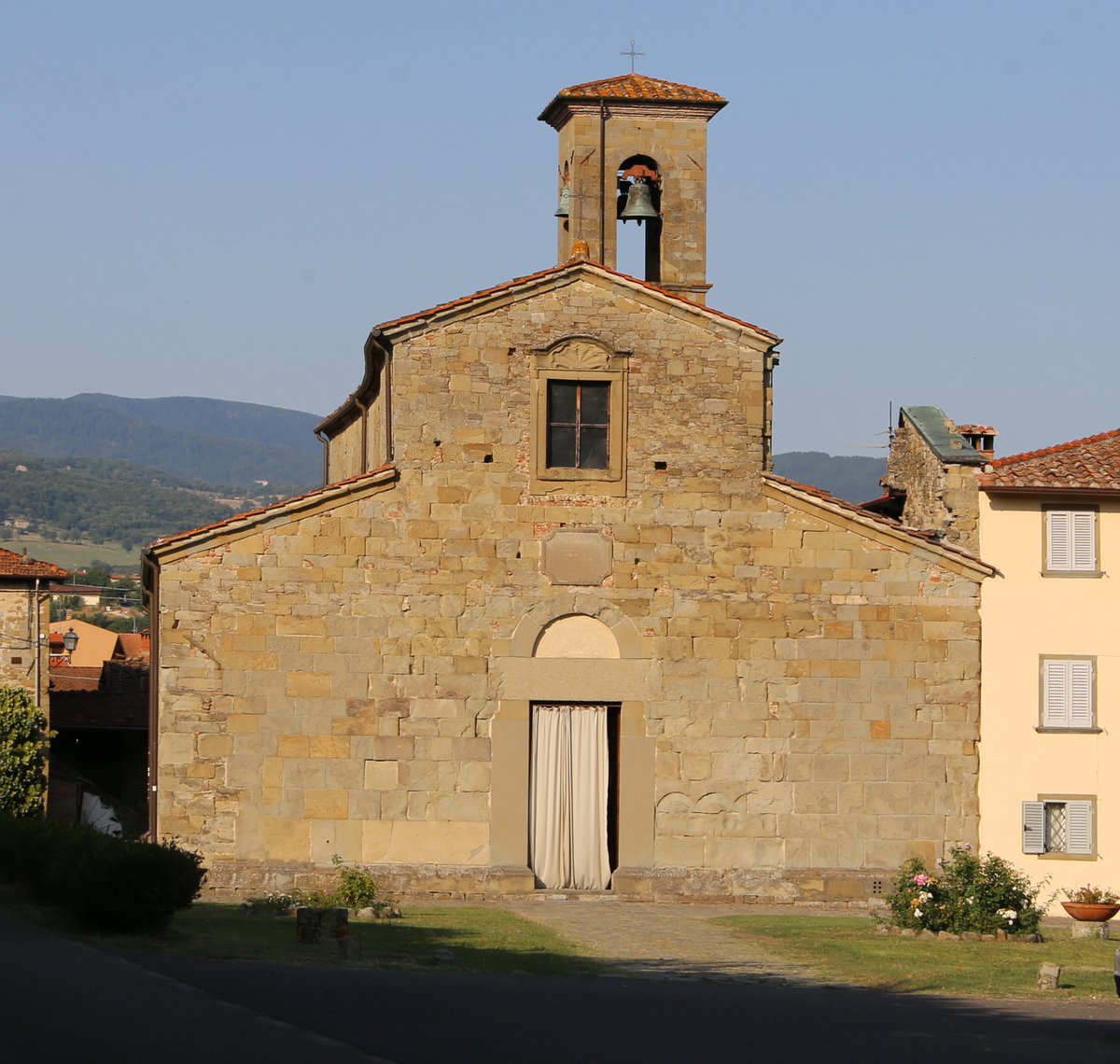

For a thousand years, the church at San Martino a Vado has been known by the same name. It's a testament to the enduring importance of this place in the Casentino valley of Italy. But the story of its construction, its changes, and what remains of its past is a more complex tale. Let's explore.
The first church dedicated to San Martino a Vado was mentioned in 1028, but the one that stands today dates back to the 12th century. According to an old tradition, it was built under the will of Countess Matilda of Canossa, but more likely it was initiated by the Counts Guidi living in the nearby castle. The church underwent several renovations, the most significant being those after the flood of the nearby Solano river in 1745. After that flood, the church took on a late Baroque appearance.
The church was rebuilt in the 1960s but was built on ancient foundations. The columns in the nave feature 12th-century capitels, each of different design, influenced by French models. The anonymous Lombard sculptors depict various human and zoomorphic figures, volutes, stars, and leaves.
The church houses fragmented frescoes transferred for conservation reasons from the adjacent Church of San Niccolò and Castello. On the right wall, there's a large transferred fresco from the 14th century depicting St. Nicholas with saints. On the left wall, there's another 14th-century fresco of a Crucifixion, also from the Giottesque Florentine school. In the counterfacade, there's a group of parts from the 14th century, including an Annunciation and angels.
A 1617 painting, San Michele Arcangelo between Saints Peter and Bartolomeo, is on the left wall. Another painting, Madonna conferring the scapular to St. Simon Stock and other saints, is dated to the early 18th century. Giovanni Antonio Pucci, an ally of Gabbiani, is believed to have painted the early 18th-century painting.
A 1605 painting, Madonna del Rosario and Saints, by Francesco Mati, was moved to the altar major at Santa Maria a Spalanni. A 1626 painting, Immaculate Conception with Saints Francis and Andrew, is in the Oratorio della Visitazione di Strada. A 1650 painting, Madonna with the Child appearing to St. Anthony, was moved from the altar dedicated to the saint in the same Pieve.
Sources: Wikipedia, OpenStreetMap, Wikidata, Wikimedia Commons
Written by Nicolo Ciampini
Discuss this with the author and others
No comments yet. Be the first to start the conversation.