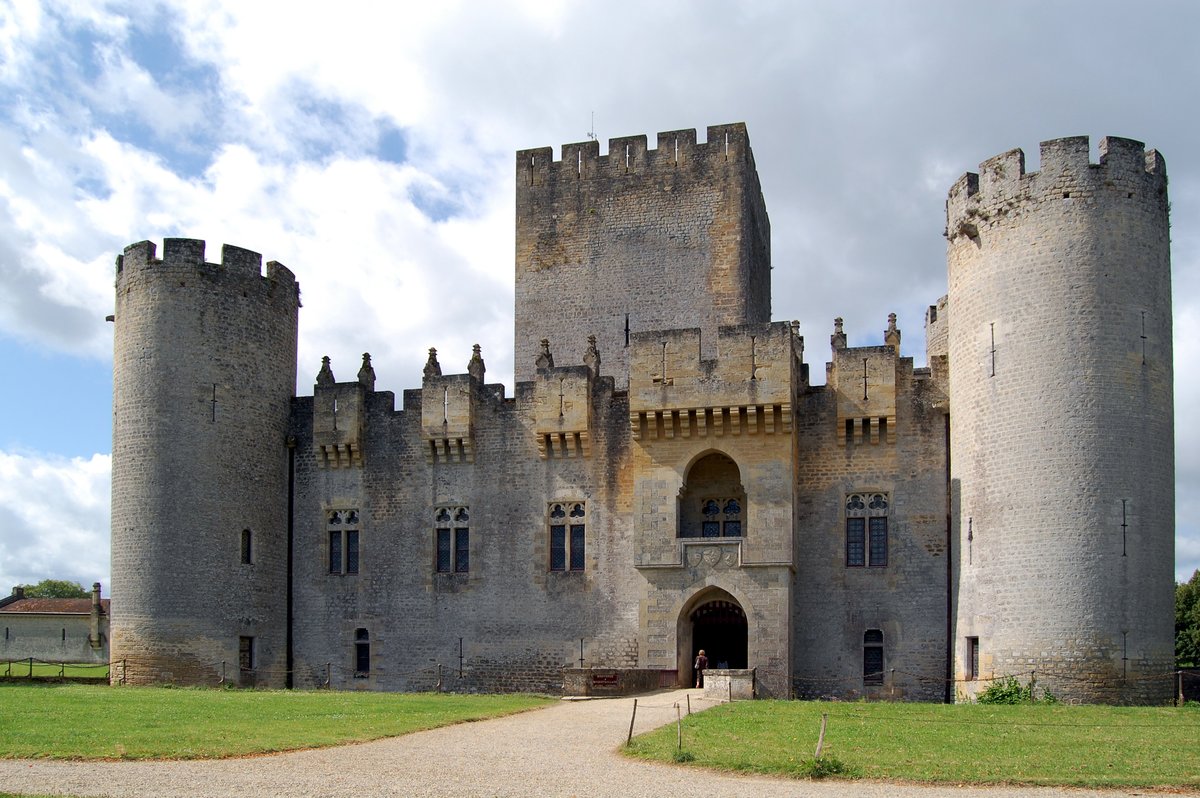

The Château de Roquetaillade, situated in the village of Mazères, France, near Bordeaux, is a striking example of medieval architecture. Its official name, Château de Roquetaillade, means 'carved in the rock'. The castle has a storied past, starting with its origins as a wooden fortification, possibly built by Charlemagne in the 8th century. Over the next 400 years, there were periods of unrest and invasions, and the castle evolved. In the 11th century, Roquetaillade was a fortified village with a feudal system.
The current stone castle, built in 1306 by Pope Clement V’s nephew Gaillard de Lamothe, replaced the wooden one and is similar in architecture to castles built by Master James of Saint George in North Wales. The castle has a square plan with six towers and a central keep, and its architecture marks the apogee of 'defensive science' before the arrival of gunpowder. The feudal system died out in the end of the Middle Ages, and the castle was used as a dwelling.
In 1599, the Lansacs modified the first floor with windows, and in 1865, the Mauvezins employed the renowned architect Eugène Viollet-le-Duc to modernise the old building. Viollet-le-Duc accepted because he considered it the perfect castle, and his renovations marked the missing link between Gothic art and Art Nouveau. The extraordinary interior decorations were listed as French Heritage in 1976 by the French Ministry of Culture. The castle has been open to the public since 1956.
Sources: Wikipedia, OpenStreetMap, Wikidata, Wikimedia Commons
Written by Nicolo Ciampini
Discuss this with the author and others
No comments yet. Be the first to start the conversation.