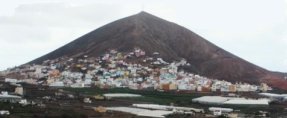

Located in the town of Gáldar, the Painted cave is an archaeological museum and park in the northwest of Gran Canaria, Spain. This centre is part of the Spanish Ministry of Culture, Historic Heritage and Museums of the town council of Gran Canaria. Inside are found some of the most representative archaeological vestiges of pre-Hispanic Canaries, with characteristics unique within Spain. The site is considered as the "Sistine chapel" of the former inhabitants of the island, the Canarii.
The cave is a superb example of artistic representations of the ancient natives of Gran Canaria. Its walls are decorated with geometrical patterns which archaeologists think could be a sort of calendar due to their regular distribution, usually in series of twelve. The site is also the only location on Gran Canaria that brought proof of the existence of common wheat on the island. Additionally, it is the only location where painted pottery has been found in the Canary Islands.
After being closed in 1982 to protect the paintings from environmental damage, the site underwent 24 years of excavation and restoration. It reopened on 26 July 2006 as a protected cultural asset. Visitors today can explore the settlement that once spread from the bottom of the valley up to the present city centre, a hamlet occupied from the 6th century until the 11th century, and again from the 13th century until the 16th century.
Sources: Wikipedia, OpenStreetMap, Wikidata, Wikimedia Commons
Written by Mutabor
Discuss this with the author and others
No comments yet. Be the first to start the conversation.