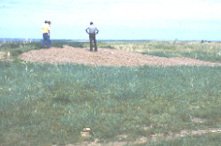
The Fort Thompson Mounds are a series of low, earthen mounds. They begin at the eastern end of the Missouri River's Big Bend, extending downriver along the bank, past Fort Thompson and the Big Bend Dam. Typically, these mounds rest on a terrace higher than the river's typical level in the early 1960s and are believed to be burial sites, some of which cover older cultural materials. The mounds date from Plains-Woodland times (c. 800) and reveal evidence of the first pottery-making peoples in the area.
These sites were known but not studied until the 1950s, when the United States Army Corps of Engineers planned the construction of Big Bend Dam as part of a flood control project. Beginning in 1957, archaeologists began digging to better understand these sites and to perform salvage archaeology on ones likely to be submerged by the dam's waters. Additionally, features of habitation, such as stone hearths, pottery fragments, and tools, were discovered, and one site yielded radiocarbon dates of c.
2450 BCE. These mounds are approximately 50 feet above the river's typical level in the early 1960s and 15 meters above the river's bottomlands.
Sources: Wikipedia, OpenStreetMap, Wikidata, Wikimedia Commons
Written by Leroy
Discuss this with the author and others
No comments yet. Be the first to start the conversation.