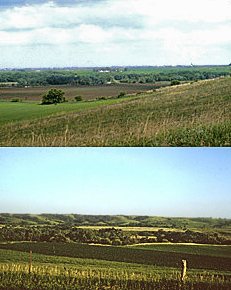
Originally home to the Oneota Culture's earthworks and structures, the Blood Run Site has been populated for 8,500 years. The site was shared by various groups, including the Ioway, Otoe, Missouri, Quapaw, Kansa, Osage, and Omaha people, and was also a regular trading spot for the Arikara, Dakota, and Cheyenne.
The site was named Blood Run because of its iron-stained soil. While it was mapped by French voyageurs in the early 18th century and once contained about 480 mounds, it has been significantly impacted by human activity. Settlers and looters destroyed large areas through the late 1930s, and a possible snake mound was used for railroad fill.
In the late 19th century, 176 mounds were still visible at the site. Today, 78 mounds remain, most of which are burial mounds. Although declared a National Historic Landmark in 1970, the site's integrity remains endangered by looting and gravel quarrying. Portions of the land have since been acquired by the states of Iowa and South Dakota to establish state parks.
Sources: Wikipedia, OpenStreetMap, Wikidata, Wikimedia Commons
Written by Leroy
Discuss this with the author and others
No comments yet. Be the first to start the conversation.