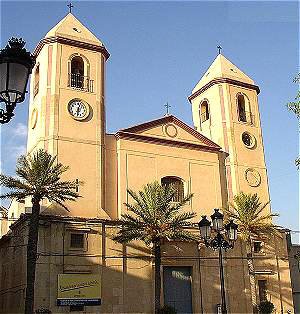

The Iglesia de Nuestra Señora de la Asunción in Villanueva del Río Segura, Spain stands tall and imposing, a bastion of neoclassical architecture overlooking the valley below. But beneath its current facade lie complex stories of debates, movements, and adjustments spanning eight centuries of history. It all started with a power struggle between two towns over the claimed status of their local churches. Ulea, with roots tracing back to Roman times, claimed superiority, while Villanueva, though younger in history, laid claim to a mezquita converted to a church under the reign of Fernando the Catholic.
The debates over which church reigned supreme stretched from the 16th to the 18th century, and it was only in 1783 that Ulea was deemed the preferred church. This victory was short-lived, as the rising tensions in the early 19th century saw the work on the Villanueva church halted, with the assets sold off. Not until 1795 did construction begin, due to these debates. Fernando VII, in an effort to resolve the dispute, requested that Juan de Villanueva, the famous Spanish architect, take over the work in 1859.
De Villanueva, who had already designed the church in Madrid and the real oratorio in Aranjuez, was a natural choice. With the help of his successor José Ramón Berenguer, the construction finally resumed in 1860. The new design that Villanueva proposed, however, was controversial. He aimed to build an exact replica of the Pantheon in Rome, but the plan was abandoned and a neoclassical design was chosen instead. The new church, completed in 1882, was a far cry from what Juan de Villanueva had originally envisioned.
Like a phoenix rising from the ashes, the church of Villanueva has survived the test of time, but the story of its construction remains a testament to the power of debate, the ebb and flow of history, and the will to persevere.
Sources: Wikipedia, OpenStreetMap, Wikidata, Wikimedia Commons
Written by Nicolo Ciampini
Discuss this with the author and others
No comments yet. Be the first to start the conversation.