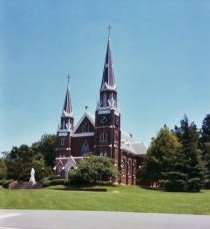
Father Jeremiah O'Connell bought 500 acres of the former Caldwell farm in 1876 and handed it to the Benedictines in Pennsylvania. He wanted a school in North Carolina, and the monks delivered. They decided to use red clay to build the monastery and college, creating the distinctive look you see today.
By 1884, Pope Leo XIII officially declared the monastery an abbey. Father Leo Haid took the helm as the first abbot. He was a busy man - he founded a seminary in 1886 and was soon appointed Vicar Apostolic of North Carolina. In 1888, he became the first American abbot-bishop.
Construction on the Abbey Church of Mary Help of Christians began in 1892. It is a Gothic Revival brick structure with a cruciform plan and two towers of unequal size. It is a solid piece of architecture, but the interior holds a grim reality. The church contains a baptismal font carved from a stone that was once used as a platform for selling African American slaves in the North Carolina market.
Today, the site functions as a motherhouse for other abbeys and remains a functioning college. The monks still run the show, which includes a nursing program and a maternity center called Room at the Inn. It is a massive operation of faith and brick, still standing since the 19th century.
Sources: Wikipedia, OpenStreetMap, Wikidata, Wikimedia Commons
Written by Kyle McLonely
Discuss this with the author and others
No comments yet. Be the first to start the conversation.