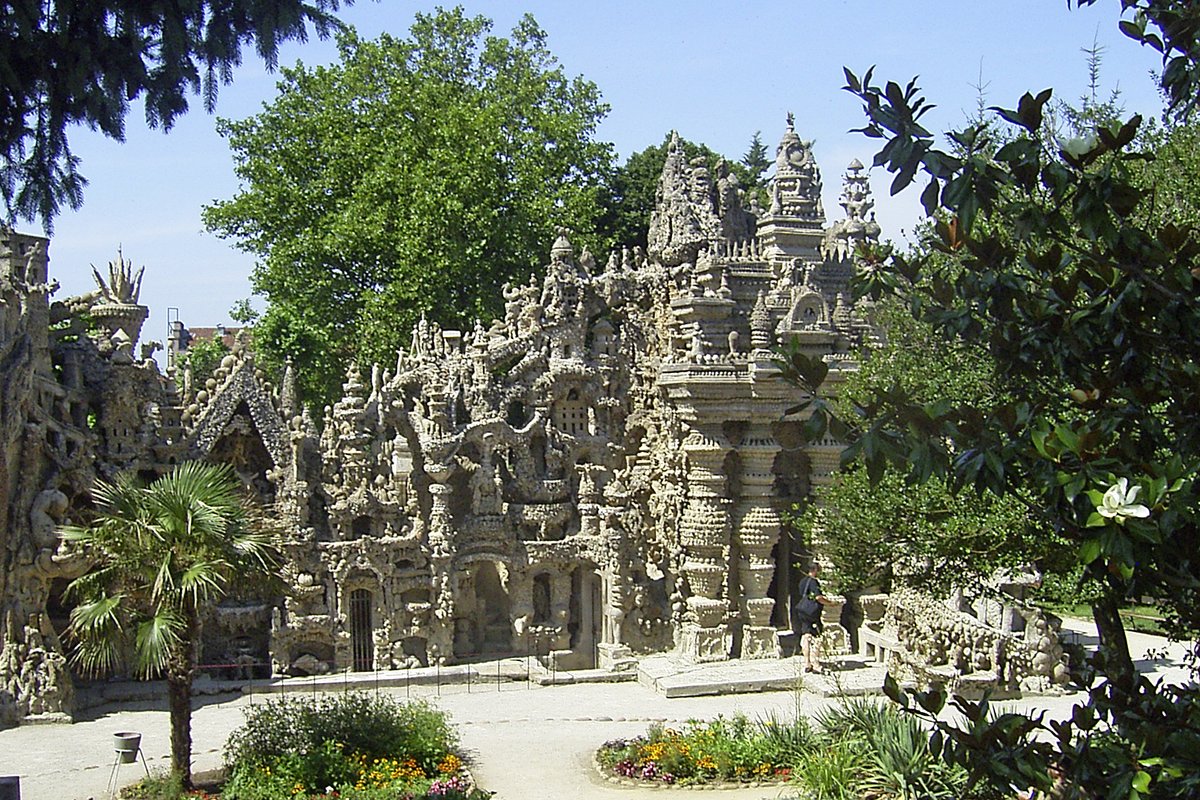

A baker's apprentice who became a mail carrier, Ferdinand Cheval reasoned that if Nature was willing to do the sculpture, he would do the masonry and the architecture. For thirty-three years, he gathered river-washed stones, pebbles, and fossils. He carried them home first in his pockets, then in baskets, and eventually in a wheelbarrow.
He often worked at night, by the light of an oil lamp. The palace is a mix of different styles, with inspirations ranging from Christianity to Hinduism. The North façade feels like a mossy forest, while the East façade features an Egyptian-style temple-like structure with two waterfalls called the Source of Life and the Source of Wisdom. On the north façade, he carved animals including lions, dragons, and a polar bear.
He even carved his weary statistics into the wall to mock anyone who thought they could outdo his 10,000 days of struggle. It is a temple to Nature, expressed by a vision of a class of cunning, hardened survivors.
You can visit the Palais Idéal today to see the result of this work. The palace is sprinkled with short quotes and poems hand-carved by Cheval, including the iconic phrase: "1879–1912 10000 days, 93000 hours, 33 years of struggle. Let those who think they can do better try."
Sources: Wikipedia, OpenStreetMap, Wikidata, Wikimedia Commons
Written by Nicolo Ciampini
Discuss this with the author and others
No comments yet. Be the first to start the conversation.