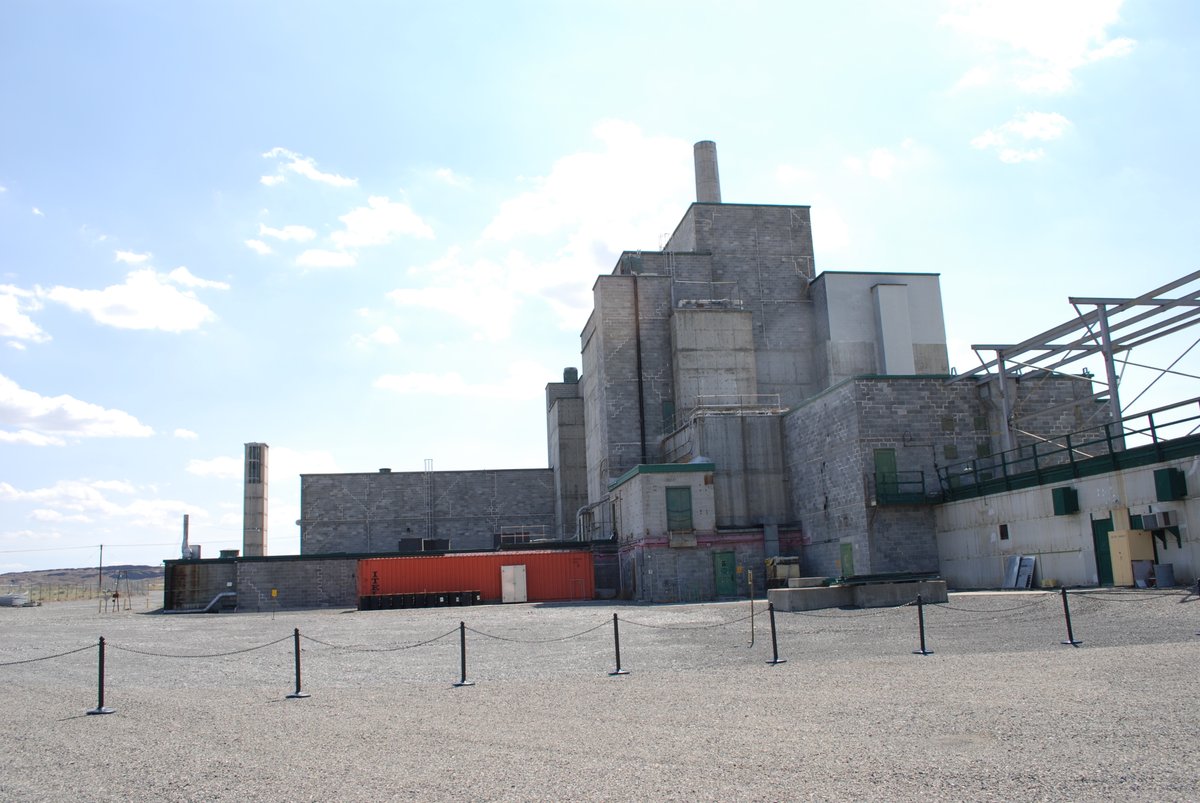
The B Reactor at the Hanford Site, near Richland, Washington, was the first large-scale nuclear reactor ever built, with a capacity of 250 MW. It achieved criticality on September 26, 1944, and served as a vital component of the Manhattan Project. Its purpose was to convert natural uranium fuel into plutonium-239 by neutron activation for use in nuclear weapons. This process was an alternative to uranium enrichment plants in Tennessee because plutonium's distinct chemistry made separation simpler. The reactor was primarily constructed by DuPont, with assistance from scientists including Enrico Fermi, John Archibald Wheeler, and Chien-Shiung Wu.
The facility was graphite moderated and water-cooled, with coolant pumped from the Hanford Reach of the Columbia River through aluminum tubes and around uranium slugs. It was preceded by the X-10 Graphite Reactor, which had a capacity of 4 MW, meaning the B reactor represented a leap of two orders of magnitude in reactor design. Two other reactors, the D Reactor and F Reactor, were launched in December 1944 and February 1945. The plutonium produced at the site was used in the Trinity test, the Fat Man bomb detonated above Nagasaki, the demon core, and thousands of US warheads during the Cold War.
The B reactor was permanently shut down in February 1968. It was designated a U.S. National Historic Landmark in 2008, and in 2011, the National Park Service recommended its inclusion in the Manhattan Project National Historical Park. Today, visitors can take a tour of the reactor by advance reservation. The buildings have since undergone a process called cocooning, where the structures are demolished up to the 4 ft-thick concrete shield around the reactor core.
Sources: Wikipedia, OpenStreetMap, Wikidata, Wikimedia Commons
Written by No Other
Discuss this with the author and others
No comments yet. Be the first to start the conversation.