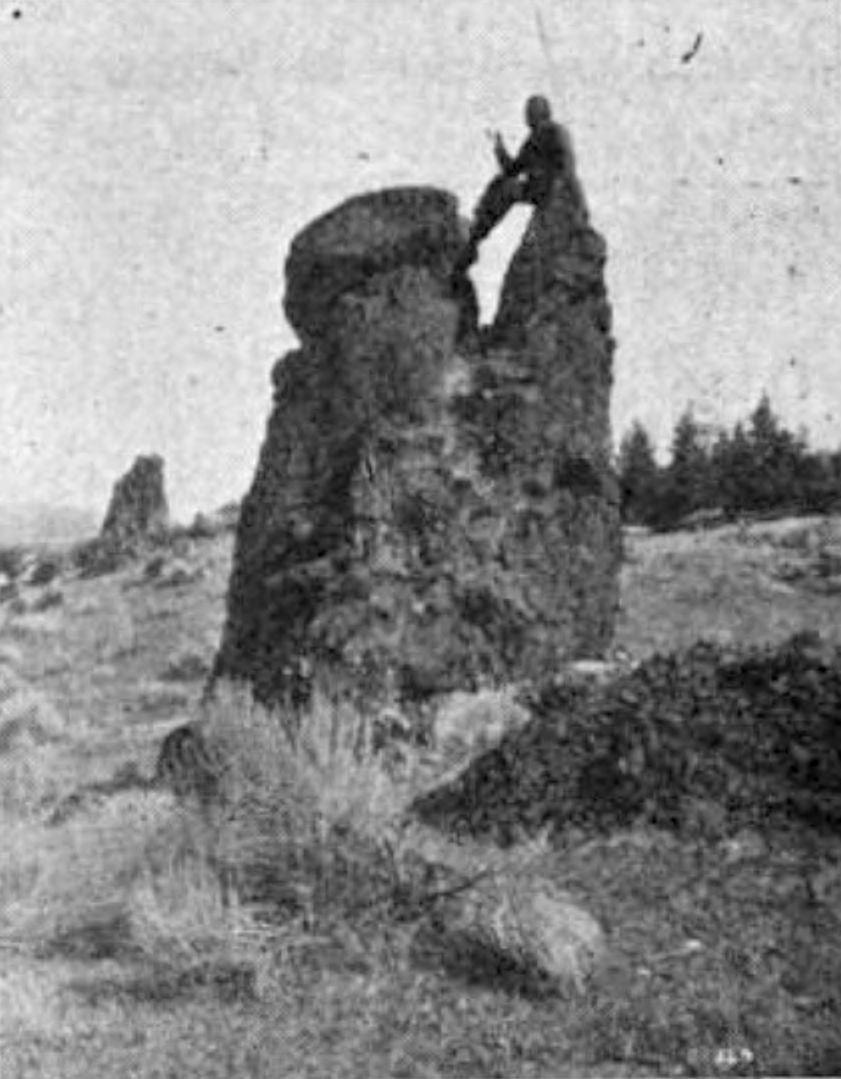

Pulpit Rock stands in the modern-day city of The Dalles, Oregon, carrying a history that stretches back to the 1830s. The site was originally home to the Wascopam Mission, a branch of the Methodist Mission opened at Celilo Falls in 1838.
Reverends Daniel Lee and Henry K.W. Perkins established the Wascopam Mission on March 21, 1838. The mission was often called Wascopam after the local Wascos, who provided much of the lumber for the buildings. The site included a schoolhouse, garden, stable, barn, and two dwellings, along with a cleared pasture adjacent to the wood huts used by Native American villagers. Supplies were procured from Hudson's Bay Company stations at Fort Vancouver and Fort Nez Percés, as well as Methodist stations at Mission Bottom and later Mission Mill. During one supply trip, provisions dwindled to the point that a horse had to be consumed until salmon could be purchased from a Clackamas village.
Pulpit Rock is a rock about 12 feet tall, carved by natural elements in an open area on a slight slope. The Methodist missionaries preached at the location, finding some initial success in converting some of the local Indigenous peoples. Today, the rock stands at the intersection of E. 12th and Court streets in The Dalles, Oregon. It is located directly south of The Dalles-Wahtonka High School and features a historical marker. A mural in downtown The Dalles features the rock prior to the development of the current roads and neighborhood around it.
The Wascopam Mission was sold for $600 to Marcus Whitman in 1847, but following the Whitman massacre and the eruption of the Cayuse War, the mission was occupied by the Oregon militia. It was returned to the Methodist Mission in 1849 because the ABCFM had yet to pay for the station. During the 1850s, the U.S. Army developed Fort Dalles on the site. The remaining indigenous people inhabiting the surrounding region were evicted by the U.S. Army to the Warm Springs Indian Reservation, and the location eventually became the center of the modern town of The Dalles.
Disputes arose in the 1870s between the settlers of the Dalles and the Methodist Church, which still considered the area their property. Litigation reached the Supreme Court in 1883, where the judgment rejected the Methodist claims in favor of the settlers. Three years later, the church gave $23,000 to settlers who had previously paid for lots on the now defunct claim.
Sources: Wikipedia, OpenStreetMap, Wikidata, Wikimedia Commons
Written by Friendly Jane
Discuss this with the author and others
No comments yet. Be the first to start the conversation.