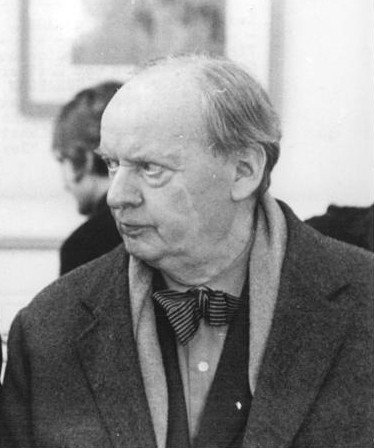
Bernhard Hans Henry Scharoun inhabited the tension between visible reality and imagined space. While many of his colleagues fled the Nazi shadow, he navigated Germany, crafting public architecture that adapted outwardly to political specifications. During the Nazi era, he built a few family houses, such as the Schminke House in Löbau in 1933, where the interiors maintained his personal style despite external requirements.
During the dark years of the 1930s and 1940s, Scharoun secretly recorded architectural ideas and visions in numerous watercolors. He used these watercolors to mentally prepare for life after the Nazi regime. After the war, his role in rebuilding the city became more formal. In 1946, the Allies appointed him to the city building council, and he was named director of the Abteilung Bau- und Wohnungswesen des Magistrats.
Teaching at the Technische Universität Berlin, he moved from private homes to rebuilding the capital. He presented conceptions for the reconstruction of Berlin and the Berlin City Palace in an exhibition titled Berlin plant - Erster Bericht. His masterpiece, the Berliner Philharmonie, was designed between 1956 and 1963. In this concert hall, the spectator ranks rise in irregularly placed terraces around the music podium, while the ceiling planes layer like a tent-like firmament.
Scharoun remained a prolific creator, drafting designs at sixteen and entering competitions by eighteen. Although he did not complete his studies at the Technische Universität Berlin, he designed the Romeo und Julia apartment towers in Stuttgart and the German Embassy in Brasília. Even his work from the late 1920s, such as the house in the Stuttgart Weissenhof Estate, showed a clear architectural vision.
Today, his legacy survives in both monumental and domestic structures. The Schminke House in Löbau, a 1933 commission, stands as an accessible example of his work from that era. In Berlin, his name is tied to the Philharmonic. This structure hosts global music within a shell of concrete originally painted in white and ocher, a far cry from the private watercolors of his study.
Sources: Wikipedia, OpenStreetMap, Wikidata, Wikimedia Commons




Written by Aurora
Discuss this with the author and others
No comments yet. Be the first to start the conversation.